I. Introductions
Lara Strahan placed her tray on the cafeteria table, next to her lecture notes. She did not have time for a leisurely lunch across-campus in the staff cafeteria, and would just catch some ‘student fare’ today. Her class would meet in forty minutes. She had already reviewed her notes for today, and could spend time skimming through the campus newspaper.
“Hi,” a friendly voice greeted her. She looked up, and recognized a fellow professor, whose name and departmental affiliation she had forgotten. “I’m Steve Coventry. I’m in the systems engineering department here. I’m pretty sure we’ve met at one meeting or another. I’d like to ask you a question – do you mind if I join you?”
As the gentleman reached for the back of the chair on the opposite side of the table, she returned the greeting. “No, not at all. Be my guest.” It was well past the ‘rush’ lunch hour, and there were not a lot of students in the cafeteria at the time. The room was fairly quiet, and they could speak in normal voices. As Steve pulled the chair to the table and sat down, Lara asked him, “What’s on your mind?”
“Well,” he began, “I saw the notice on your talk last week, on the negative effects of globalization, and decided to sit in on it. I was quite impressed. You really laid it on the line about where we are headed. You probably don’t do much speaking to major multinationals!”
Lara laughed. “You’re right. My message isn’t warmly received in most quarters. I guess that’s why I enjoy being in academia. So, what’s your question?”
“Well, let me start first by saying that I’ve done some thinking of my own on the subject of the impact of industrialization on the biosphere, and I have reached the same conclusion as you have – that mankind’s large numbers and industrial activity are destroying the biosphere, are leading to the extinction of millions more species, and will eventually lead to the extinction of mankind itself. As the quality of the environment and quality of life degrades around the world, more and more people are finally admitting to this inescapable conclusion. I agree with your assertion that there has to be a substantial decrease in global industrial activity if we are to solve the problem. You plead a strong case in support of Herman Daly’s ‘steady-state economics.’ The question that I have is: How in the world do you think that that is possible? In other words, you seem to see where we need to go, but you don’t provide any information or insight on how to get there from here. So, that’s the question.”
“You come right to the point. Well, let me start by saying that the lecture wasn’t advertised as a solution – it was advertised as a diagnosis of the problem. Everyone admits that the problem is complicated, and does not have an easy solution. The point to my talk was that we have to move to a system of planetary management that is based on ‘steady-state,’ or ‘equilibrium’ economics, rather than on ‘growth-based’ economics, as we have today.”
“But people have been talking about the problem for a long time now. Granted, not many people until just the last few years. In fact, most of what you hear is still denial of the seriousness of the problem, and expressions of hope that ‘technology’ will help us find a way out of our predicament. So, will your next talk give us the answer?”
“No, not yet. My next talk addresses the issue that while ‘steady-state’ economics is necessary, it is not at all sufficient. My point will be that even if we stopped economic growth in its tracks right now, the present level of economic activity is vastly too large for the biosphere to support.”
“Well, hardly anyone is saying that! What are you proposing? A vast decrease in the human standard of living, or a vast decrease in the total human population, or both?”
“I just told you what my second talk is to be about, and you are already asking about the third!”
“I’m really curious. As I mentioned, I have thought a lot about the same problems that you’re talking about, and I wondered what your solution might be. On the lecture notice, you are described as a ‘political scientist.’ I thought that political scientists talked mostly about politics, and you’re talking mainly about economics and the environment.”
“Political science and economics used to be the same field – you can still get PhDs in ‘political economy’ in some countries, such as Canada. But the flyer was correct, I am a political scientist, not an economist, as people today generally understand and use those terms. This distinction reflects and underscores, in fact, my view on what the nature of the solution to the world’s environmental problem will be – the solution will be essentially political, not economic, in nature.”
“I hope that I’m not treading on dangerous water here, but politicians are generally held in lower esteem than economists, when it comes to protecting or saving the environment.”
“There are all sorts of political systems – you probably haven’t heard of the one I have in mind.”
“What is it?”
“I just told you that you’re two talks ahead of me. As a systems engineer, I’m pretty sure that you’ve never even heard of what I have in mind.”
“Try me. Some systems engineers can read!”
Lara had to laugh at this fellow. He was genuinely friendly – not up-tight as so many of her friends-in-academe. Should she let him know what she had in mind? Probably not a good idea. She hadn’t even decided whether she would give the third talk on what she had in mind.
“You’re stalling,” Steve remarked, breaking her brief reverie.
“It’s on synarchy,” she said, before she realized it. Oops! That was stupid. Oh, well, he seems harmless enough. But she still didn’t want to make a commitment of any sort to speaking on something that was still not clear in her own mind.
“Synarchy? Synarchy? You’re right – I’ve never heard of synarchy. Do you mean ‘synergy’?”
“No, you heard me right. The word is ‘synarchy,’ not ‘synergy.’ But, I really must tell you, I haven’t even really decided on the exact topic for my third talk. It probably won’t be about synarchy at all!”
“Now you’ve really piqued my curiosity. What is synarchy?”
Lara looked at her watch. “Oh, Steve, I’m sorry, but I’ve really got to go. I had lunch in the student cafeteria today because I didn’t have time for a real lunch. I enjoyed talking with you – we’ll talk again sometime,” she said, as she stood up, picking up her lecture notes.
“Wait, wait,” he pleaded. “I didn’t mean to pry so, but I really am very interested in the topic that you obviously spend a lot of time with, and I would like to talk further with you. Will you have dinner with me on Saturday night?”
Wow, Lara thought to herself, this guy’s a fast mover. But he seems very nice. Quite unlike many of her coworkers. But is he just wasting her time? Is he really interested in the world’s critical environmental problem? But he is a systems engineer. Maybe he would have some insights that she didn’t have. And she didn’t have any ‘attachments’ at all at the time. What the hey! All she had to lose was a lonely Saturday night.
“Aren’t you married, Steve?” she countered, not because she thought he was, but just to make him work a little bit.
“No, not at all! Not even a serious girlfriend. I’m serious – I really want to learn more about what your point of view. So how about it? What type of cuisine do you like? French? Italian? Greek? I’ll pick you up at your house at seven o’clock.”
“OK, how about French,” she responded, smiled, and gave him directions to her house.
II. A Meeting of the Minds
Steve was right on time. He had a nice, late-model sedan. It was large and comfortable – cloth seats.
“My dad always liked Lincolns,” she remarked, as they moved down the street away from her house.
“Can’t beat ‘em for power, smoothness, and quietness,” Steve added. “And you can’t beat a rear-wheel-drive car for acceleration.”
Lara thought for a moment about her dad. He had always liked big, powerful cars – sedans and station wagons. And his reasons were about the same as Steve’s. Power. Acceleration. Must be a ‘man’ thing. There really was a difference.
Steve must have noticed the silence, and the gap in the conversation. “Tell me about yourself, if you don’t mind,” he asked. “How long have you been at the University of Maryland? Where did you get your doctorate? Where are you from?”
Lara glanced over at him. He wasn’t bad looking, and he appeared to be in very good shape. Tan complexion, tall, lean, clean-cut, short hair, no beard, nice clothes. Sort of a prototype systems engineer, she imagined. “Well, your questions cover a lot of ground. I grew up in Memphis, Tennessee. I guess that I always wanted to go to Vanderbilt, and so I did. I did my undergraduate degree in mathematics. Not because I was particularly interested in math, but because it seemed to relate to so many other fields. I was interested in almost everything I studied, and I suppose that I thought that I would pick a different major in my sophomore or junior year. By the time I graduated, however, I had developed a pretty serious interest in economics and environmental science, but I had decided that political science was the field I was most interested in. There was no question that I wanted more education, and I decided to go to the University of Virginia for graduate work. I got my MS and PhD degrees from Virginia. I wrote my dissertation on alternative political systems, with particular reference to their concern for nature and the environment.”
“But if you were interested in economics and the environment, why did you pick political science for your field of graduate study?”
“The main question was whether I wanted to talk about something or do something about it. To me, political science seemed to be closer to ‘action’ than any of the hard sciences. And I had pretty much decided that economics was more a part of the problem than of the solution to the planet’s woes.”
“Wow, that’s a pretty strong view for someone with just a bachelor’s degree. Did something happen to persuade you?”
“Well, yes, as a matter of fact. Have you ever heard of Nicholas Georgescu-Roegen?”
“No, who’s he?”
“Georgescu-Roegen was a Romanian who emigrated to the US in 1948. He was a mathematical statistician. He earned a doctoral degree from the Sorbonne, and did postdoctoral work under Karl Pearson. Most people think that he was an economist, since he did most of his work in economics. Sort of like John Maynard Keynes – a mathematician who most people think is an economist. He joined the faculty of Vanderbilt in 1949, and remained there until his death in 1994.”
“So what did Georgescu-Roegen do? Did he develop some new economic theory? Why did he impress you?”
“Georgescu wrote what is regarded by some as the most important treatise on economics since Adam Smith’s Wealth of Nations. It is called, The Entropy Law and the Economic Process.”
“Entropy? Do you mean ‘entropy’ as a physicist uses the term? The second law of thermodynamics?”
“Yes, exactly. Most economists view that the environment is simply a subsystem of the economy. Georgescu argued forcefully that it is the economy that is a subsystem of the environment. And the key fact associated with that point of view is that, for the system to continue, the environment must reprocess every bit of the waste produced by the economic system.”
“Well from the viewpoint of physics, that’s pretty obvious. What was so fundamental about that?”
“Well, practically all of today’s economists refuse to acknowledge the fact. They view the economy as an ‘open system’ that simply accepts inputs and produces outputs. They refuse to acknowledge that the outputs are wastes that must be reprocessed by the environment for the system to go on. The environment is viewed simply an ‘externality.’”
“You’re kidding! The second law of thermodynamics has never been seen to fail. There has never been an exception to it. In a closed system, every process increases the entropy, or disorder, of the system. You have to continually add more energy to the system from an outside source to keep it going. In our case, the ‘closed system’ is Earth, and the outside source of energy is the Sun. How can anyone, economists included, deny that the ‘law of entropy’ doesn’t hold?”
“You got me! It’s bizarre, but true. You should have a talk someday with Herman Daly, on the Maryland staff. He wrote a book, Steady-State Economics, and another one, Beyond Growth, in which he discusses all of this. In fact, he includes a chapter summarizing Georgescu’s contributions in Beyond Growth. The situation in present-day economics is similar to that in Copernicus’ and Galileo’s time, when the Establishment – the Church – refused to entertain the idea that the Earth revolved around the Sun, instead of vice versa. Georgescu’s idea has been rejected just as Copernicus’ was. It is as fundamental a paradigm shift as switching from Newtonian physics to Einstein’s relativity and quantum physics, or from creationism to evolution. I guess big changes don’t come easy in any field. By the way, Georgescu wasn’t the first to view the essential role of entropy in economics. The Nobel-Prize-winning chemist Frederick Soddy was the first person to make a strong point of it – he’s the one who railed against economic systems that allow for compound interest, and fractional reserve banking. And the economist Kenneth Boulding, too. Daly discusses all of this, in Beyond Growth. I was introduced to it through Georgescu, who was at Vanderbilt.”
“So how did Georgescu make an impression on you? Was it the significance of what he was saying, or was it his personal charisma. And why didn’t you study economics, if Georgescu’s theories impressed you so?” Steve queried.
“Well, I told you that I studied a lot of different subjects as an undergraduate. Including economics. I attended a lecture of Georgescu’s once, and I was really impressed with what he had to say. But the most amazing thing that struck me was that his name did not appear in any of my economics textbooks, or in any of the standard references – even though The Entropy Law was published by Harvard in 1971. It was a stunning case of total denial. The entire field of economics, it seemed, simply was denying that he existed, and that there was any merit to what he said. There weren’t even any counter-arguments to his theories – since there could not be. So the entire field of economics, throughout his career, simply ignored him – at least for his work on entropy. Total denial. In 1994, he died, a bitter man, totally unrecognized for his fundamental contribution.”
“But you just said that Herman Daly talked about him in his book.”
“Yes, that’s true. Herman Daly is about the only prominent economist who recognizes that an economic system based on continued growth simply cannot go on. And he recognized the fundamental contributions of Soddy and Georgescu-Roegen. He used to be with the World Bank. They didn’t appreciate what he was saying – that’s probably why he left. He’s been at Maryland ever since. Our good fortune.”
“You didn’t answer my questions,” Steve interrupted. “How did Georgescu impress you, and why didn’t you study economics – from Georgescu’s viewpoint?”
“What impressed me was that what he was saying made perfect sense. I had studied physics as an undergraduate, and I knew about the laws of thermodynamics. It was very clear that the whole field of traditional, established economics was a sham. On the one hand, with stars in my eyes, I wanted to shout this to the world. But on the other, I saw what had happened to Georgescu-Roegen. The field of economics had crushed him, because he pointed out the terrible flaw in their system. I had no intention of joining a field that was so corrupt. When I went to graduate school at Virginia, I decided to major in political science. To be sure, I was still interested with economics – it runs the world – and I studied it further. But the more I studied it, the more disaffected I became with its denial of the role of entropy and the fact that the economic system must operate fully contained and harmoniously within the environmental system. I studied some more environmental science, too, but my heart wasn’t in it. I had come to realize that the solution to the environmental crisis facing the planet would not be solved by environmental science, and certainly not by economics. The solution would be political. And so I studied political science.”
“I can see why you didn’t go for a PhD in economics or environmental science, but why political science? Political science is an academic discipline, not a field of social action. You have asserted that the solution to the world’s environmental crisis will be political, but the solution will require action – politics, not political science. Political science is concerned with studying, analyzing and understanding political phenomena – politics is concerned with managing political systems, or changing them. The analogy is similar to studying ‘business’ in college and being an entrepreneur. The old saying: those who do, do; those who can’t, teach. Caesar and Genghis Khan and Napoleon and George Washington and Roosevelt weren’t political scientists – they were military men or politicians. Are you planning to go into politics? If so, you don’t need training in any particular field to do so – you can be movie star, or a bodybuilder.”
“What you’re saying is correct – a political scientist is not a politician. But you can’t be a practicing physicist, or chemist, or mathematician, or physician, or a competent practitioner in any field that involves a significant body of knowledge and technology, without studying these fields at university. I am convinced that the solution will be political, and I am preparing myself to be a part of that solution. The problem is very complex, and I need a lot of knowledge and understanding to help solve it. You’re right that today’s politicians may have any sorts of backgrounds. But look at the mess we’re in! I’m hoping for something better. I want to understand what’s going on, and figure out how to change it – and then change it! But I’m doing all the talking. What about you? Fair is fair. Tell me about yourself now.”
“We’re almost at the restaurant – let me wait till we’re inside. By the way, I hope that I don’t seem to be judgmental, or criticizing your decisions. I have faced some of the same issues that you have, and I am very interested in not only the decisions you made, but why you made them. And I just about ‘fell off my chair’ when you mentioned the word ‘entropy’ – I’ll tell you why inside.”
Steve parked the car, and they walked into the restaurant. He had made reservations for a booth, and they did not have to wait.
They ordered drinks and appetizers. “So what is your life history, Steve?” Lara asked, continuing the conversation from the car.
“I’m a ‘Southerner’ too – born and raised in Savannah. I got a BS in physics from Georgia Tech, and a PhD in systems engineering from MIT. Along the way I picked up a lot of background in mathematics, statistics, and operations research. Unlike you, I haven’t discovered any massive flaws in my fields of endeavor, but quite like you, I have become very concerned over the fact that none of the science and engineering that I have studied is helping to solve the world’s environmental crisis. We understand what the problem is, and are looking at it square in the face: too many people, too much industrial activity. But we – as a species – seem completely helpless to do anything about it.”
“You say,” Lara interjected, “that you are interested in the global environmental problem. But what have you done about it? Have you studied it in detail? Have you reached any conclusions?”
“Yes, as a matter of fact, I have. Have you ever heard of Professor Jay Forrester of MIT?”
“No.”
“Well, have you ever heard of Limits to Growth, or Beyond the Limits, by Donella Meadows?”
“Of course. Those books describe simulations that show that the world economy is doomed to collapse, no matter what.”
“Well, the system simulation models of the type described in the Limits books are based on ‘system dynamics,’ which was originally developed by Forrester. As his theories were applied, they collected fancier titles, such as Industrial Dynamics and World Dynamics, but in essence they are all the same basic system-simulation concept.”
“The Limits books have generated a lot of controversy. Most people don’t place much stock in them. The models are simple representations of reality that ‘collapse’ whenever a limit is reached on some critical resource. But in the real world, things don’t work that way. Whenever one resource is depleted, technology finds a way of substituting something else for it. Sort of like substituting glass fibers for copper wires, or nuclear energy for fossil fuel.”
“You’ve been reading too much Julian Simon – another famous Maryland faculty member, rest his soul.”
“Well, what I have been working on recently is system models that are concerned with energy, and entropy, and ‘throughput,’ rather than physical resource utilization and limits. In essence, I represent the global environment as a big, but closed, system for reprocessing industrial waste. The global economy is converting low-entropy (high-grade) energy and raw materials to high-entropy waste, and the global environment is reprocessing the industrial waste back into low-entropy products. The major source of energy to keep the process going at the present is oil. For the long term, however, the sole energy source is the Sun. That’s what keeps the system going.”
“So what have you found out?”
“What I’ve found out is that, as long as human numbers remain high, and as long as there is even a modest level of industrial activity, the system – the biosphere – always collapses. Under a solar-energy system, there simply isn’t enough energy to reprocess any appreciable amount of industrial waste. In the short run, while we have fossil fuels, the environmental system quickly becomes overloaded, and the system collapses catastrophically. Even if you assume the use of a non-solar long-term energy source, such as fast-breeder nuclear reactors, the biosphere still eventually collapses. The biosphere is in essence a solar-powered waste-processing factory that runs at a certain rate, determined by the solar radiation flux, and all it can handle is the amount of waste that a solar economy produces. That’s what it evolved to do, and that’s all it can handle. You can’t input a lot of ‘extra’ energy into the system without upsetting it.”
“So, according to your models, how many people can the Earth support, long-term?”
“The answer to that question depends on what level of living you assume for the human population. Historically, the planet has been seen to be capable of supporting from about five million to eighty million primitive people with very little impact on the biosphere, and up to a few hundred million with minimal impact – where by ‘minimal impact’ I mean a system that can continue for millions of years with very little change and very slow change to the species composition of the biosphere. But if you allow some of the people to use high technology, the numbers drop dramatically. A ‘technological’ or ‘industrial’ person uses about one hundred times as much energy as a primitive person. Very roughly, for every high-technology person on the planet, you have to reduce the primitive population by about 100, if the biosphere is to be able to reprocess the waste. If the high-tech person reprocesses some of his own waste – particularly the industrial waste, so that all that’s left is biodegradable – then the reprocessing burden imposed on the biosphere drops, but then he consumes even more energy. As an example, a high-tech population of five million uses about as much energy as a primitive population of five hundred million, if it reprocesses all of its waste. So if you want to run the planet on its natural solar-energy flux, all it can stand is a high-tech population of on the order of 2-5 million people.”
“Those numbers are really low! Let me make sure that I understand this correctly. The planet can support at most 2-5 million people, if a high-technology level of living is assumed?”
“Well, that’s not quite correct. In addition, you could still have some portion of the 5-80 million primitive people around. They impose little burden. In addition to a very small high-technology population, you could still have a primitive population of, say, five or ten million people, geographically distributed over the planet, without changing things very much. For example, the planet could probably support, indefinitely and with essentially no human-caused impact on the biodiversity of the biosphere, a population of five million high-tech people and a population of five million primitive people.”
“Wow, this is really interesting!” Lara was quite excited, and it was showing. She leaned over the table, her voice dropping almost to a whisper. “Have you discussed this with others?”
“Well, not really. I’m not the first to propose these numbers. They were proposed on the Foundation website several years ago, and got nothing but denial and rejection. Their line of reasoning was essentially the same as what I just told you. In other words, I already know what to expect if I announce my findings. I’m not about to blow my career on this, when I know what the certain reaction will be. It’s the same road that Georgescu-Roegen went down. The human population does not want to hear that the planet can support at most ten million people in the long term. It doesn’t matter what the arguments are. It’s really a case of all or nothing, and it looks as if human society is opting for nothing.”
“I know what you’re saying. But I’m still a little puzzled. Daly and a few others are talking more and more about long-term equilibria. Even the UN and World Bank are beginning to talk about the human population peaking at about nine billion in 2050 and then dropping to a long-term equilibrium of, say, three to six billion by 2100 or 2150.”
“Those numbers are totally absurd, from two points of view. First, it is quite evident that the planet cannot support even six billion people, only a sixth of whom are highly industrialized, without destroying the biosphere. Second, China and India are now speaking of raising the standard of living of their populations to our levels. That will destroy it even faster. Finally, world petroleum production is about to peak, and then decline. You know, Hubbert’s Curve – you’ve read Thom Hartmann’s The Last Hours of Ancient Sunlight, or Richard Heinberg’s The Party’s Over? As soon as it does, global famines and resource wars will begin. In my view, the world will never see a human population of nine billion. And when it does fall, it will collapse catastrophically. The UN and World Bank visions of a global population slowly declining to an equilibrium, steady-state level are absurd. Have you read William Catton’s book, Overshoot? The human population long ago surpassed the carrying capacity of the planet. There is no way it can possibly ‘gracefully decline’ to a steady-state level.”
“Do your models show this? Or are you making this up – hypothesizing it?”
“No, they show it. Over and over. No matter how many different runs I make, the results are always the same. It is simply not possible for human population to reach the point where it is making a significant impact on the biosphere, or where it is using most of the planet’s solar energy, without causing a catastrophic collapse.”
“But no one who is talking about a steady-state human population is talking about five or ten million people globally. Those numbers are absurdly low. They always talk of a population of one-hundred to several-hundred million people – maybe even a billion – and all enjoying a high standard of living. And they always talk about a ‘managed’ or ‘controlled’ collapse. These are educated, responsible, ethical people. Are they deliberately deceiving, or terribly wrong?”
“A pipe dream at best, and a cruel deception at worst. But mostly the former. What you are seeing is denial. It’s the same as economists and Georgescu-Roegen. It doesn’t matter what the facts are, or how logical the arguments are. People will simply not accept the fact that the human population will soon plummet catastrophically. And they are so used to having billions of people around that they think that that is natural. It is not natural. Large human numbers have directly caused the extinction of millions of species, and massive drops in all large animal populations.”
“Steve, I’m having a hard time with this. I was convinced that the world would have to move away from ‘growth-based’ economics to ‘steady-state’ economics, and I didn’t believe that we could have a world of six billion industrialized people, since the world can’t even support six billion people of whom only a sixth are industrialized, without destroying the biosphere. But a steady-state population of only ten million! That is hard to believe. And your argument that catastrophic collapse is inevitable – that we will achieve a steady state only after global war and famine. Surely there is a way out.”
“A way out? Not an easy way out, to be sure. The near-term future is certain to be violent. There is no way around that. And there’s no real point to agonizing over that, or trying to do much about it. The overshoot has already occurred. It occurred several centuries ago, when the human population started to industrialize and to grow to one billion and beyond.”
“So what are you saying? The world is doomed?”
“Not at all. I’m too much of an optimist for that. What I am saying is that massive change will happen, and that the global population will soon drop tremendously. But what I’m also saying is that there are population mixes that can survive indefinitely. Such as five million high-tech people and five million primitive people. The challenge is to find out how to bring such populations about. And that is why I approached you in the cafeteria the other day. You’re the political scientist. I’m the systems engineer. I know what population sizes are feasible for long-term survival of the biosphere and the human population. But I don’t see how to bring them about politically. That is your area of expertise. That is your job. So what do you propose? What is this ‘synarchy’ stuff you were telling me about the other day.” Steve stared directly into her eyes.
Lara’s head was spinning. On the one hand, she was thrilled at meeting someone who was concerned about the same issues that she was. But on the other hand, the dire predictions he was making were shocking. Steve was not a Bible-belt student prophesying the end of the world. He was a respected scientist, and, if his models were correct, he was predicting the imminent end of the world as we know it. But what could she tell him? She was not just the political scientist she had represented. How much should she tell him? Could she trust him? She was, at the moment, completely off-guard. She needed time to think. She wasn’t ready to lay all her cards on the table. She hardly knew this man. He would have to wait.
“Steve,” she began, “you have told me a lot of things, some of which I believe and some which are quite difficult to believe – shocking, even. Before I discuss my ideas further, I need to know more about what you are doing. I need to see your models, your assumptions, and convince myself of their validity. Do you understand? I’m sorry, but my head is about ‘maxed out’ with all you’ve told me. I need time to digest it. Can we get together in your office or lab, and you show me more of what you are doing? Then, we can talk more. Also – and I’m being perhaps brutally frank here – I hardly know you. Before I discuss some of my ideas with you, we need to know each other more than we do. I hope that you understand what I’m saying.”
Steve smiled. He was so relaxed. The world was about to end, and he was leaning back in his seat, as if he were a teenager having a milkshake in a malt shop. “No problem,” he responded. “Let’s enjoy Saturday night out. Let’s order our entrées. All work and no play makes Jack a dull boy!”
III. Dialogue
Lara and Steve met twice over the next couple of weeks. At the first meeting, Steve explained some of the work he was doing in modeling the world’s future. He explained some of the differences between his models and the standard Forrester system-dynamics models. Including explicit consideration of energy and entropy was just one of the differences. A big difference was including random variation – his models were highly stochastic, not deterministic, and they often included game-theoretic aspects.
“I use the system dynamics models just for simulation of the near-term future, not for the longer term,” Steve explained.
“Why is that?” Lara asked.
“Several reasons. First, any system representation of planetary dynamics that we might specify will soon be out of date. If you look at the recent history of the world, the process is not at all stationary – it is highly nonstationary – it’s evolutionary. In statistical terms, it is not even what is referred to as homogeneously nonstationary. In fact, at the present time it’s not just evolutionary, it’s explosive. Whatever model I might specify today will not apply for very long.”
“So what good are your models?”
“Well, they are fine for understanding the very near term – for shedding light on what might happen next, such as will it be oil or water or food that is the next big resource constraint, and what is likely to happen when that constraint starts to ‘kick in.’”
“Can you tell me what your models say about the maximum sustainable size of the human population – what the ‘steady state’ population level might be?”
“Here we go again!”
“What do you mean?”
“Everyone is always asking what the maximum sustainable human population is. And that is exactly the wrong question to ask. The phrase ‘maximum sustainable human population’ is an oxymoron. The population – and the biosphere – can never be sustained if there is any attempt to maximize it, or even make it big. Besides, who says that having a large human population is good at all? It isn’t. The only people who need a large population are rulers and capitalists – a few very powerful or rich people controlling, exploiting and benefiting from a very large number of poor people – as Solomon once remarked, ‘A large population is a king’s glory, but without subjects a prince is ruined.’ A very large human population doesn’t serve any useful purpose. A large human population simply displaces and destroys much of the biosphere. It destroys much of the biosphere’s biodiversity. It makes the world a very much less interesting place to be. The best solution, in terms of a rich biosphere that not only ensures a very large number of future human beings, but, more importantly, produces maximal enjoyment for all time, is a very small human population. A minimal-sized human population, not a maximal-sized one. Species diversity is extremely important – both from ecological and an esthetic viewpoints – and any attempt to maximize human numbers destroys that diversity. The more people, the fewer other species.”
“But even people like Daly speak of maximizing the number of people over all time as a reasonable goal – a way of achieving sustainable development. In Beyond Growth he recognizes the drawback of trying to maximize the number of people alive today, and he suggests that the solution is to maximize the total number of lives over all future time. The only way that that can be done is if the present population is constrained to a level that leaves the biosphere in good shape, so that future generations continue to thrive. And if the goal is to maximize the number of human lives over all time, it seems rather obvious that it is necessary to maximize the number of people alive at each point in all time. Don’t your systems models show that? If you minimize the human population at any time, you end up with zero people!”
“I’m sorry, Lara, and with all due respect, but you’ve completely missed the point. Any attempt to maximize the total human population over all time is doomed. Besides, that is a nonsensical approach. What is the benefit of maximizing the number of people over all time? Of what possible benefit is that? The point is to minimize the likelihood, the probability, if you will, that the human race goes extinct, subject to having minimal impact on the biosphere. The number of human beings alive at any given time is irrelevant. All that matters is that the likelihood of extinction of the human race – from human causes – is kept as small as possible, and that the impact on the biosphere is as small is possible. Now, it isn’t possible to minimize both of these things, since they compete to some extent. There is always a tradeoff. Human activity will always cause some impact on the biosphere, since human beings compete with all other life forms for space and resources. The issue is whether the system remains rich in biodiversity, and changes very slowly. I am tempted to use the term ‘equilibrium,’ but it isn’t really appropriate since the biosphere is always gradually changing, evolving.”
“So what you’re saying is that there is an optimal number of people, if the goal is to minimize the likelihood of human extinction and preserve the biodiversity of the biosphere? So what is the correct size of the human population? The optimal size, that keeps the likelihood of human extinction low and planetary biodiversity high?”
“Well, you’re a little closer, but you’re still putting the emphasis on the size of the human population, when the focus should be on the likelihood of human extinction and destruction of the biosphere. The total size of the human population is, by itself, irrelevant. There isn’t any ‘correct’ size – we shouldn’t even be looking for ‘optimal,’ with respect to size. The size of the human population is not the key issue. If you focus on the two items I mentioned – the likelihood of human extinction and the destruction of the biosphere – then the number of people takes care of itself. If you focus on trying to have a lot of people on the planet, you end up losing, every time. You either end up with a ruined biosphere, or human extinction, or both. Aiming for a large human population is posing the wrong problem. Have you ever heard of John Nash?”
“The ‘Beautiful Mind’ John Nash? John Forbes Nash?”
“Yes.”
“Well? What’s he got to do with this?”
“Well, as you know, Nash pioneered the theory of nonzero-sum, or general-sum, games. In a zero-sum game, one player wins what the other player loses. Lots of games are zero-sum games. John von Neumann and Oskar Morgenstern developed the theory of zero-sum games, a long time ago – the famous ‘min-max’ solution. But the game of human existence on Planet Earth is very much not a zero-sum game. It is a nonzero-sum game, in which all species are competing for space, but if any one species gets it all, or even too much, then all life, or much life, becomes extinct, and they all lose. Nash considered general-sum games, in which the players may cooperate as well as compete. He proved the existence of a solution for which the players could achieve better outcomes by cooperating than by acting unilaterally. This solution is called the Nash Bargaining Solution. One of the features of the Nash Bargaining Solution is Pareto optimality, which arises in economics.”
“So do your models include solutions to the nonzero-sum ‘game of life’?”
“Well, some do, but not the important, long-term ones. For the long term, the solution is even simpler.”
“Simpler? But the farther you go into the future, the more uncertain things are, and the harder it is to specify the problem, much less its solution.”
“You’re right. So what you do is look at the basics, or essentials, of the problem – those aspects that remain constant over all time.”
“And what are those?”
“Well, you look at the system in which human beings survived for millions of years, and you see that they survived by being a very small part of a very big system. All species did. Over time, a few new species come along, and a few go extinct. But as long as nothing happens that is ‘large’ with respect to the biosphere, diverse life goes on forever – or as long as the Sun shines! They key to survival is making sure that human population never gets so large that human activity is making a significant impact on the rest of the biosphere. This includes not only not generating more waste than the rest of the planet can reprocess, but also just not taking up much space. Human beings, a single species, now consume – utilize for human purposes – almost half of the solar energy reaching the planet. And that is why millions of other species are going extinct. The so-called ‘Sixth Extinction’ of the planet’s biosphere.”
“Are you leading up to something, or just pontificating?” Lara interjected.
Steve laughed. “Yes, I’m leading up to something. The point is that if you keep human numbers small and human existence simple, the chance of extinction or biospheric collapse from human causes is also small – essentially zero. As long as the human population operates within a rather small range, then the biosphere goes on essentially forever. Of course, an asteroid or volcanic eruption or pole shift may wipe everything out, but I’m not talking about that – I’m talking about extinctions from human causes – mass species extinction from human overcrowding and industrial activity, and greenhouse-gas death from global warming. And here’s the point. Once human population size reaches the level where it starts to ‘mess’ with the biosphere at a macroscopic level, the chance of a catastrophic human-caused event becomes non-negligible. Maybe it’s still very small, but that doesn’t matter. We’re talking about rare events, but over very long time periods. If the likelihood of global collapse is only one in a thousand per year, then global collapse is likely to occur within a thousand years, and quite likely to occur within two thousand years. The point is that if you want to avoid extinction from human causes, the per-year extinction likelihood has to be essentially zero – not one in a thousand, not one in a million, but essentially zero. And there is only one known way of accomplishing that – to keep the human population – and human activity – as low as it was for the millions of years that the human race thrived before the present era. You don’t need fancy models at all! We already know the answer! We have, as Foundation referred to it, a feasible solution.”
“So that’s your solution? Keep the human population at a few tens of millions, for all time? But that’s not a solution at all! That may be a characteristic or a result of the solution, and it may actually be a way of achieving a solution, but the ‘solution’ should include a description of the process by which the result is achieved. Saying that nuclear power is a solution to the sixteenth century’s energy crisis is fine, but it is of no value whatsoever unless you show people in the sixteenth century how to refine uranium ore and build a nuclear reactor. Simply specifying some characteristics of the solution isn’t enough. That, as I recall, was one of the problems with John Nash’s theory – he described the characteristics of the solution, but didn’t tell how to find it!”
“You’re right, Nash provided an ‘existence’ proof, not a ‘constructive’ proof. And your comments are in order. But existence proofs arise all the time in mathematics. In information theory, for example, Claude Shannon proved the fundamental theory of information and coding in 1948, many years before the brilliant mathematical statistician R. C. Bose developed actual codes – the BCH codes – that Shannon proved were possible. Existence proofs are fine – they show what is possible, and what the characteristics of the ultimate solution are, even if they don’t show how to get there. In the case of the current planetary environmental crisis, I know what the characteristics of the solution are – a low human population, on the order of what existed for millions of years – and I am the first to confess that I don’t see how to get there. Every time you talk about population control, people start levying charges of murder and genocide and eugenics and such. But that’s where you come in. That’s why I was curious about the lecture you gave. I’m a physical scientist, and I know what works and what doesn’t, from a physical viewpoint. But I am not a sociologist or a psychologist. I do know the characteristics of the solution. I am absolutely convinced of that. I just don’t know how to achieve it – how to bring it about through human social or political action. And that’s where you come in. You’re the political scientist, the social scientist. Can you see a way to get there from here?”
Lara was nonplussed. A rush of thoughts raced through her mind. Steve was talking about changing the entire world. He was addressing head-on the very problem that was the focus of her life. And what he said made sense. She had looked at his models, and saw their strengths and limitations. She realized that what he was saying about the size of the human population was right on the mark. He accepted the solution, he was not in denial at all. But how to bring that about? Maybe it was time to tell him more. But what would he think? Some of his ideas were far out, but his feet were placed solidly on the ground. Everything that he had talked about was objective, rational, empirical – based in logic or experience. Her ideas were really far out. They weren’t physical science at all – they were spiritual science – metaphysics. They weren’t objective, they were subjective. She couldn’t prove them at all. Could she trust him? Would he laugh at her? She had not gotten to her current station in life by promoting any of her personal, secret, ideas. But that is exactly what was needed to answer Steve’s questions. No, she would wait. She would think things over. She would sleep on the matter, and discuss it the next time they got together. Maybe she should talk about her ideas out of the context of the world’s environmental crisis, and outside of her professional realm.
“Steve, you’ve got some really good ideas, and you just may be right. You have really ‘thrown down the gauntlet’ to me, in asking for a way of bringing about a solution. But I’ve got to reflect on what you’ve told me. I do have some ideas, but I’ve got to think about them in the context of what you’ve told me. Then, if I see that I can help, we’ll talk. But I need some time to think.”
Steve smiled, and they agreed to talk in greater detail at a subsequent meeting.
Over the next few days, Lara thought a lot about the next step. She couldn’t stall any longer. The more she thought about Steve’s ‘solution,’ the more she became convinced that he was right. Steve had indeed thrown down the gauntlet to her. It was time to fish or cut bait. But her solution approach was quite unlike Steve’s cold, rational, logical, objective approach. Her approach to problem solving was not based in logic at all. It was quintessentially subjective in nature. It was based on feelings and emotions and intuition and creative insights – on dreams and visions, not on logical proofs and mathematical models. She decided that, at their next meeting, she would initiate a discussion about her approach, but she would speak only in general terms, not in the specifics of the planetary crisis.
Their next meeting was at her house. Their first meetings had been in public places – a restaurant, Steve’s office at the university. They both liked each other’s company. Their relationship was becoming more than just the planetary crisis, and ways of dealing with it. She liked Steve, and she could tell that he liked her. Their relationship was easy, comfortable. It flowed. There were no awkward moments.
“Can I fix you something to drink?” Lara asked, as Steve walked into the main room.
“Yes, that would be great. How about a café latte?”
“Sure. Coming right up. Join me in the kitchen.” Lara and Steve moved to the kitchen, where Lara set about making the café latte. As she handed the mug to Steve, she said, “There are some nuts on the counter, too, if you wish.”
“Thanks, Lara. This really hits the spot.” They moved back to the living room. Steve chatted for a few minutes about some friends he had bumped into yesterday. After a few minutes, he broached the subject.
“I’m sure you’ve given some further thought to our recent discussion. Any thoughts, ideas?” Steve began.
“Well, maybe, but first I want to talk about some other things.”
“Sure, what about?” Steve responded, smiling. He always smiled. At times it seemed that he was too agreeable. Most men were a little pushy, a little aggressive, a little selfish – that was natural and expected. But Steve seemed different. He had his opinions, to be sure, and he was very convincing and assertive and enthusiastic about them. But he was not at all argumentative. Whenever she expressed an opinion, he seemed genuinely interested not just in the idea itself, but in why she thought what she did. Nonjudgmental. He let her explain her position. He asked questions, and often probed for more details, but he never tried to talk her out of her position. He seemed to just accept that as a given. On the other hand, he didn’t seem to want to waste time ‘pleading his own case.’ He presented his reasons for his beliefs, and let it pretty much go at that. He admitted that he did not have solid proofs for everything. He was very logical, but he didn’t seem to mind taking a few ‘leaps of faith’ when logic failed to provide all the answers.
“Steve, you and I have talked a lot about the environmental crisis, and we have talked some ‘small talk’ as well. I know a little about you, and you know a little about me. But I don’t know much about you, and you don’t know much about me. Do you know anything about mysticism?”
“Mysticism? That term covers a lot of ground. Do you mean spiritualism and the occult, or New Thought or New Age, or ‘psi’ advanced mental powers – parapsychology, the paranormal – metaphysics? Do you mean psychic phenomena, Wicca, or satanic worship, or a transcendent experience with Christ?”
“I suppose that I mean a little of all of those. What do you think about your mind, your sense of consciousness and identity, your spirit, what differentiates a dead person from a live one? What do you think of your existence, and how and why you came into being, and for what purpose? Where do ideas come from? What is the meaning of existence and life? What can we know?”
“Whoa! I’m just a simple Presbyterian! I am generally aware of all of those issues, but they are not the focus of my life. In fact, I thought a lot about some of them when I was in high school, and I soon reached the conclusion that, in this life, most people will never know the answers to life’s really important questions, like what am I, what created me, and for what purpose. Religious leaders and quantum physicists and philosophers and mystics have been trying for years to shed some light on those issues, without much success. I pretty much decided, early in life, that I wouldn’t get answers to those questions, and I should spend my time and efforts on working on questions that do have answers – on accomplishing and enjoying a fulfilling life experience, without worrying too much about the ‘whys’ and ‘hows’ of human existence. I know that Plato stated that the unexamined life is not worth living, but people have spent whole lifetimes dwelling on these issues and still never come up with any truly satisfactory answers. Actually, I did try to meditate once, but I never experienced anything unusual – that it’s a good way to relax is about the only revelation I experienced. So, my life is pretty much centered on action directed toward accomplishing whatever goals and objectives I set for myself. And that has worked pretty well. I accomplish most of the goals I set for myself, and I enjoy the satisfaction of the quest and of achieving the goal. I don’t have all the answers to life’s ‘big’ questions, but I do feel pretty good about myself. I enjoy my work and my hobbies. Life is good. Does that answer some of your questions? I really don’t have answers to all of those questions. I just live my life as I feel I should and as I feel I want to, and I don’t worry about the metaphysics of it. Some things I can control and influence, and some things I can’t. I work mainly at things that I think I can influence. I suppose it is a little presumptuous of me to think that I can help solve the planetary environmental dilemma, but lots of people are trying to do that, and it affects us all directly. It’s fair game – other people are trying to destroy it, so I have a perfect right to try to save it. It’s my world, too.” Steve looked at her, waiting for her reaction.
Lara didn’t respond directly to anything he said. Without comment or hesitation, she asked, “Have you ever had a paranormal experience?”
“No, not really. At least, no ecstatic trances or amazing visions or transcendental communion with God. A little synchronicity – that’s about all.”
“You’ve had some good ideas in your lifetime. Where do you suppose they came from?”
“They came from my brain, my mind – whatever that is! I saw a problem, I worked on it, I used logical reasoning, and I found a solution.”
“But in finding a solution, I am sure that some ideas ‘popped into your head.’ Logic isn’t sufficient to solve most problems. Some creative insight is absolutely necessary. Most scientists get an idea about what the solution might be, and then set out to prove or disprove it. They don’t just apply blind logic to every fact in the universe, and evolve logically to an answer. That’s not the nature of the creative process – or of winning chess matches, either. Insight and inspiration are absolutely necessary. Hard work is, too. But without the creative insight, nothing happens. The idea is vastly more important than the hard work to prove that it’s true. So where do ideas come from?”
“I don’t know. And I don’t really need to know. All I know is that they happen. If I am working on a hard problem, and I sleep on it, I often have a new idea in the morning. Sometimes I even wake up in the early morning with a new idea, or a hint about what to look at next. I accept that. I don’t know what my mind is, or how it generates ideas, and that doesn’t bother me a whole lot. But what are you getting at? Where are you leading?”
“Well, where I am leading is that I have very strong and very visual experiences. Whenever I have a problem, I don’t just sleep on it and get a hint in the morning. I go into a kind of trance, and see all sorts of images. I don’t see just a single solution to a problem, but I see a vast spectrum of visual images that relate to the problem, and that eventually, over time, guide me to a solution.”
“This is pretty heavy stuff. Do you talk to spirits?”
“Yes, I do, some of the time.” Lara answered. There was a rather pregnant pause. She had crossed over the line. Would he ridicule her? What was he thinking?
“What sort of visual images do you see? Are they other places? Are they other people? Are they inanimate objects? Are they disembodied spirits? Does this happen in present time?”
Just like Steve, Lara thought. No criticism, no rejection. Just an expression of a desire to know more.
“Have you ever heard of ‘astral projection’?” she asked.
“Why, yes, I have. With the New Age upon us, it is about impossible not to know something about those things. Are you a ‘channeler’?” Steve raised his eyebrows slightly, in a questioning glance.
“No, I’m not a channeler. I guess that I could be – I have conversed with many entities. But nothing ever takes control of me. I wouldn’t allow that. But you said that you knew what astral projection is. Well, that is perhaps the best description of what I experience.”
“So, where are we headed? This is pretty personal stuff. Why are you explaining these things to me?” Steve asked.
“Where we are headed is this. With your logical reasoning and subtle hints from ‘sleeping on a problem,’ you have been guided to a solution to the world’s environmental crisis. You are convinced that your solution is correct – logical reasoning helps you see that – but you have no idea about how to bring it about. What I can do is explore alternatives. I can follow future paths – many of them. I can explore where they are likely to lead. I have done this time and time again. It always works. I am convinced that, if your solution is correct, I can find a way to it.” Lara’s chest filled with a feeling of exhilaration. She was very surprised at herself. She had not meant to go this far. She just wanted to discuss her strange experiences in general, non-personal terms, not to describe them in detail, and certainly not, at today’s meeting, to propose them as a means of solution. She had really done it now! She had exposed herself totally. She had never done that before. She felt very vulnerable. What would Steve’s reaction be?
“Lara, do you have any objective proof that your method works? Have you used it to determine a solution to an objectively verifiable problem? You used the term, ‘astral projection,’ which implies that you are one entity observing or interacting with other entities. But maybe it’s all in your mind, and there is no interaction with anything else at all.”
“That doesn’t matter. Of course astral projection is subjective. And, for whatever reasons, it does not lend itself to objective validation. But that doesn’t matter at all. All that matters is that it works. And I have proved that to myself time and time again.”
“Proved to yourself. That’s the key phrase.”
“I was afraid this would happen. I can’t prove anything about what I can do. It is indeed totally subjective. I can’t empirically validate it at all. But I know that it works. You can’t explain why the universe exists, or how gravity works, or why you are alive, or how your heart beats, or how you can think, or where ideas come from, or what your mind is. You can’t prove that reality exists, and that this is not all part of a big dream. Does that invalidate all of those?”
“Point taken. But the scientific method, based on empirical reasoning – observations, logic, experimentation, and tests of validity – are what makes the world go ‘round. You may be right that I can’t explain where ideas come from, but I can subject them to objectively verifiable tests of validity.”
“I have no problem with that. Every vision I have I subject to critical evaluation by logical reasoning. What is exceptional about my projections is that they are incredibly varied, incredibly clear, and they always seem to include a right answer, or at least guidance to it. They are vastly more useful than the hints obtained from sleeping on a problem. They are creative insight magnified to the n-th degree. I know that I can explore many paths in detail. Many are dead ends, of little interest. Some are ‘off the wall.’ But some lead to fabulous conclusions. I can control them to a limited extent, such as deciding what I want to look at, but to a large extent they have lives of their own. Most of them are logically consistent and physically possible, and I recognize that they all need evaluation in the cold light of day. Each path I see can be subjected to objective evaluation – the same processes involved in your models. You might think of my projections as hypotheses. Indeed, they are. But, despite the fact that I can’t explain how they happen, they are testable. They are just as valid and useful as the hints that you get from sleeping on a problem, or that may pop into your head while daydreaming. And I know that you follow up every one of those!”
“Hmmm,” Steve mused, “you have a good point. What you say is interesting. I think that I am beginning to see why you are telling me all this. The next step is rather obvious. Can you use your ability to generate some candidate ‘paths’ for getting to the solution – to a long-term-sustainable, biospherically friendly solution to the planetary crisis?”
“Yes, I can,” she said, seriously and solemnly.
“Lara, you know that the Establishment has little use for metaphysics. It’s OK for an idea to pop into a mathematician’s head from out of nowhere, but it’s not OK to receive ideas as full-blown visions. People will only accept what they’re familiar with, even though they can’t explain how that works, for a moment. It would not be a good idea to discuss this with others. I am intrigued by what you have told me, and I would like to follow it up, but I have no intention of exposing my career – or yours – to the certain ridicule that would follow if people found out that we were using metaphysics to solve the world’s environmental crisis. Have you discussed this with anyone else? Who knows of your metaphysical adventures?”
“You are the first. I began having visions – astral projections – in my teens. This didn’t bother me too much, since the New Age literature is filled with this sort of thing. But it was very clear that mainstream academia had no respect for anything metaphysical. I simply kept things to myself. I have used my abilities to good effect – I can almost always get what I want, if it’s worthwhile – good for me and good for others. But, until today, there was never a reason to tell anyone. The only reason I am telling you is that it appears to me that neither you nor I can solve the crisis separately, but it may well be the case that we can, by combining our complementary skills, and working together. I do not have your analytical skills, and you do not possess my creative insight. Both are needed. Together, I believe that we can solve the problem.”
“Lara, I think you may have something. Your ‘woman’s intuition’ may be just what the doctor ordered.”
“You laugh at ‘woman’s intuition.’ That attitude is what got the planet into this fix in the first place!”
“What do you mean?”
“Things work well when there is a balance. Although the universe is unitary, most aspects of it can be viewed as dual in nature. Light and darkness, life and death, peace and war, matter and energy, male and female. The most pervasive aspect of human existence, of course, is the duality of male and female. The female nature is associated with feelings of nurturing, understanding, compassion, harmony, love, family, community, nature, and peace – strong on emotions and intuition. The male nature is associated with feelings of aggression, exploration, adventure, domination, hierarchy, machines and war – strong on logical reasoning and action. Of course, you always need both aspects of a duality – in fact, ‘need’ isn’t the right word – both aspects simply define different extremes of the same thing. Things work most smoothly when both aspects are in balance. But they are not always in balance. The pendulum swings, male and female aspects take turns, and a new equilibrium is achieved. Some time ago, the god of Earth – Gaia, if you will – was female in nature – a goddess. She nurtured Earth. The biosphere was in balance. Stability, diversity, dependability. But that’s a little boring. Every once in a while, the male aspect becomes predominant – violence, cataclysmic events, major change. Several thousand years ago, the male aspect began to rise to ascendancy again. The female goddesses were displaced by male gods – gods of wrath, of violence, of change, of civilization, war, and destruction of nature. The pendulum has swung from the tranquility of the Garden of Eden to the chaos of the Tree of Life and the Tree of the Knowledge of Good and Evil. A shift from nature to civilization and economics. The male aspect has had its run, however, and times are about to change again. That is what the New Age is all about. Love and respect for nature is about to replace aggression and greed and exploitation of nature as the basis for running the planet. The desire to subjugate, exploit, and destroy nature is about to be replaced by a new system, in which mankind will live in harmony with nature. In the new system, the male and female aspects will once again be in balance, but the system will have evolved to a new, higher level – not all nature, and not all technological civilization, but a stable balance of the two. In any event, it was the male aspect that developed civilization and the destruction of nature. And it is the female aspect that will set things right. These things are true by definition, by the attributes associated with the male and female dual aspects. No insult intended – it’s just the definition of male/female duality.”
“Thank goodness! For a moment there, I thought that I might be consorting with a feminist!”
“Feminist? Of course I’m a feminist. I do not deny my sexuality. I love, respect, experience, and use my sexuality, just as you do yours. You are male, and are valued for the predominance of male attributes. Those attributes are essential to balance and evolution. For a rich, full existence, we need strength, adventure, curiosity, bravery, restlessness and fighting spirit. But we also need love, caring, nurturing, understanding, reflection, sensitivity, art, music, and peace. Life is interesting only because of diversity. A single-sex society would be incredibly boring. A life without danger and challenge and excitement would not be worth living. The planet’s soul needs and thrives on change and diversity. That is the only way that it and we evolve to higher levels of existence. But mankind is now in the process of destroying that diversity, causing a mass species extinction, bringing about a greenhouse-gas death of the biosphere, and evolving to a dead planet. The male aspects of aggression and domination and conquest are out of control. The system is out of balance. Change is desirable and necessary – but not so much change as to destroy everything. The biosphere is in mortal danger. And it is your male logic and action and my female intuition and creativity that will save it.”
“I seem to have gotten you excited!”
“Yes, you have! You obviously haven’t thought very much about male-female sexuality, beyond the aspects of reproduction and recreation. Clearly, males and females can’t continue without one another, physically. But they also need to make effective use of the many complementary aspects of their dual nature. It’s all part of the game.”
“Can you tell me, Lara, why psychics are almost always females? The few male psychics always seem to be sickly or on the verge of death. I was told once that channelers are usually female because females have weak minds – easy for disembodied spirits to assume control of. Is that so?”
Lara thought that he might be trying to distract her from continuing her treatise on male-female duality. Or maybe he was just trying to tease her. In either case, she took the bait. “Weak minds! That’s absurd! You can have a voltmeter that can measure microvolts or kilovolts. But it can’t do both at the same time. If you place a thousand volts on the microvolt scale, it will blow the meter to pieces. But does that mean it is weak? Of course not! It means that it is sensitive! It can detect fluctuations that the kilovolt scale isn’t even aware of. If you show the kilovolt scale a signal of a few microvolts, it won’t even see it. Just because a female psychic can see spirits that you men can’t doesn’t mean she is weak. It means that she is more sensitive – more able! Stronger in a different area.”
“Okay, okay, I’m sorry I characterized sensitivity as weakness. I didn’t mean to ‘ruffle your feathers.’ I see your point. But how do you know that you are seeing a spirit – an independent, separate entity – and not just imagining it. That is the whole problem with religions founded on spiritual revelation. The phenomenon of revelation is entirely subjective. No one can assess the validity of the revelation, since no one else can observe or even experience it or know its source.”
“With all due respect, that’s simply not true. We certainly can’t assess the validity based on the knowledge of the source, such as God, or a messenger from God, or something else, since we can never know the source. But we can certainly assess the validity – at least to some extent – based on logical reasoning. What I am saying is that it doesn’t make any difference what the source is, with respect to validation, since we can never know it. It doesn’t matter whether it’s all in my mind, or whether the spirits I seem to see actually exist, or whether the information is direct from God or some other creation of his. The information is exactly the same. The message is exactly the same. It wouldn’t matter to you if you got a great idea while daydreaming, or while sleeping, or while concentrating, or while operating a Ouija board, or if someone sends it in the mail. The idea stands on its own merits. Its validity – its truth or utility – will be determined in the physical world by logical reasoning, by experience, observation, experimentation, or whatever. To disparage information from metaphysical sources is completely analogous to ad-hominem attacks. Judge the idea, not the man – or, in this case, not the process. All that we are talking about here is a paradigm – a representation of how the idea arises. It doesn’t matter whether my experiences are visions from God, or from an evil spirit, or creations of my own mind – in fact, they’re all from God, ultimately, by definition. All that matters is their truth or utility, when judged by the real world. Since I can never know the true source of a revelation, I can’t appeal to the veracity or reliability of the source as an indication of validity. In our realm of existence, the validity of an idea or concept can only be determined by evaluation in the real world, not by reference to its apparent or actual, never-to-be-known source.”
“I agree with that. I see your point, and I accept it. The revelation is subjective, and we never know its source, so no test of validity can be based on the source, since it is unknown. And I’m accepting here, as you put it, that the term ‘validity’ may refer either to truth or utility. Tests of validity of spiritual revelation can only be based on empirical reasoning. I’m in total agreement. But let me get one thing straight. Are you saying that religious experiences, spiritual experiences, and dreams and visions are just different paradigms?”
“Sort of. They may be different things, or they may not. My interpretation of them – my explanation, my representation, my description, my paradigm – may be a correct representation of reality, or it may not be. What I am saying is that it doesn’t matter. If you are trying to explain the phenomenon of evolution, you may set forth a paradigm that it follows directly from the laws of physics – or any other laws that govern life – or you may set forth a paradigm that God is consciously guiding the process every step of the way, independently of his laws of physics. You can’t prove or disprove either one as an explanation for the observed facts, since they are subjective. As long as alternative paradigms are consistent with the facts, you may accept either one – preferably the simpler explanation, if you accept the principle of Occam’s razor. In the field of psychic or spiritual phenomena, alternative paradigms occur all the time. That’s because they are subjective in nature, and so there is no way of objectively proving one more valid than another.
“Another issue,” she continued, “closely related to paradigms to explain psychic phenomena is the issue of the form, or modality, of the phenomena. For example, are astral projection and channeling and spirit guides and automatic handwriting really just different manifestations of the same basic process? Are they really different, or just different ways of obtaining the same information? In reading the Akashic records, some people see a large library and books, whereas other people see some sort of movie. Some people have visions of Jesus, and others have very similar visions of Mary, or Mohammed. Since there are no objective facts, lots of different paradigms ‘fit.’ What is of greater practical significance is whether one paradigm or modality is more useful than another for making predictions, or for some other use. If you are trying to win at poker or develop a better breed of cattle, it is probably better to place your faith in the laws of probability than in Lady Luck. Both paradigms explain why you did or did not fill an inside straight. In this case, however, one paradigm probably is more useful than another – but even here it’s not always clear: some people are consistently lucky, and synchronicity is an established fact. In the matter at hand, the issue is whether my projection ability – my creative insight, whatever its source – can generate more interesting hypotheses than your ‘dumb luck’ or ‘I-slept-on-it’ ideas. It doesn’t matter whether the visions are creations of my own mind or whether I am seeing real spirits, or communing with God. It doesn’t matter whether I am reading the Akashic records, or astral-projecting, or channeling, or doing automatic handwriting, or talking with a spirit guide, or tapping into Carl Jung’s ‘universal consciousness.’ Those are just different paradigms and modalities to represent what is happening – the transfer of information. But they are all subjective phenomena. What is important is to subject my projections – however they happen to be generated – to scrutiny by logical reasoning. And that some of them turn out to be useful. Logical reasoning is, in fact, the only way we can separate good projections from bad ones. I don’t know the source, whether it be good or evil, or from me, or from a source outside of me, or from God or something else. The source can never be determined, and is therefore irrelevant. The utility of the projection, however, certainly matters – and that is determined by subjecting it to critical evaluation by logical reasoning.”
“It’s very clear, Lara, that you’ve thought a lot about the validity of your projections. You have good, solid points. I agree with all that you say. But your arguments could get you in trouble with a lot of people. If you characterize different religions simply as different paradigms, ‘true believers’ get very upset. They claim the source of their revelations to be God or a messenger from God. They can’t prove that, however, so appealing to it doesn’t establish a thing. But they will get quite angry if you point that out,” Steve remarked.
Lara laughed. “Nothing is simple, is it? Well, we have philosophized enough! So what is our next step? I believe that I know pretty much what you conceive as a long-term-sustainable human population, that will keep the biosphere intact. Is there anything else you want to tell me, to think about or to take into account?”
“No, the ball’s in your court, Madam Political Scientist. The next step is for you to identify some scenarios for me to take a look at.”
IV. A Look at the Future
Lara was a capable projector, but she did not do it a lot. She didn’t do it for idle fun. She did it mainly when she had a significant problem to solve. Deep down inside, she thought that it was a special ability and that it should be used in special circumstances, and not trivialized. She did not engage in nightly astral projections. Moreover, to be effective, the projection sessions had to be preceded by some preparation, including meditation on the problem at hand. Without suitable preparation, projections were little more than entertainment – interesting trips, but not terribly significant or beneficial. Like dreams, but vastly more interesting and exciting.
In her meditations on the Earth’s environmental crisis, Lara contemplated the state of the planet. She thought about all the different countries and organizations in the world, and imagined the future in the context of those entities. She contemplated the number of species that were being destroyed by mankind. She thought of the smallest, most timid baby rabbit. She thought of a wild tiger on charge. She thought of the power and complexity and majesty of Gaia. She let her mind go, and she was off.
Lara had projected often, and she knew what to expect. She encountered numerous entities, and engaged them in discussion. She knew from experience, however, that most such encounters were of relatively little value, other than entertainment. The problem was that most entities were not very helpful. Some were malicious, and some were playful, and were untruthful, and some were ignorant. They were just like people. So most information she took with a grain of salt. Unless it was physically verifiable, it was of little value or interest. Another problem was synthesis. Some entities were independently manifested, and some appeared to be creations of her own mind. Reality in the astral world was a mixture of synthesized creations and independent entities, and it was not always apparent at first glance which was which.
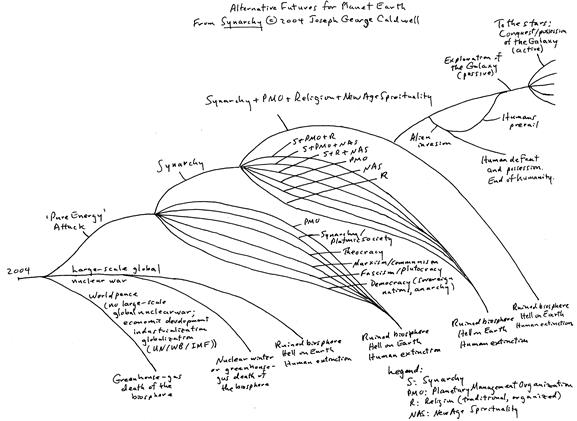
The really interesting thing about astral projection was the ease of moving through time and space. In the astral world, space and time were very fluid – the term ‘space-time continuum’ was appropriate. The problem, once again, was reliability. The past was pretty reliable, guided – constrained by – her knowledge and beliefs of history. She had a good grasp of history and geography, and what she saw in her projections generally matched what she knew to be fact, or at least as recorded history. The big problem was the future. What she saw was in fact a vast mix of possible futures. Events that seem close spatially may not be synchronized in time, or even if they were at the same time they may be at the ends of different ‘time lines,’ or ‘world paths.’ Some seemed likely, some unlikely.
Exploring the future was made easier if you traveled along a time line, or single ‘realization’ – a time-sequential sequence of events. It helped also if you restricted consideration to a particular locale. You didn’t have to do it this way, but it was too confusing to look at the future as a totally time-unordered collage of events, of different times and places. By traveling along a time line in a given locality, there was a logical progression to the sequence of events – they were spatially and temporally connected and proximate – coherent, in a sense. Without the sequencing, things just seemed to be jumbled together. An alternative was to fix a particular time, and view a lot of different places at the same future time. This was not as helpful, however, since there could be different time lines leading up to each locale, and you could not be sure whether two different places at the same future time were at the end of the same time line or different time lines. What she tried to do was view a relatively large region along the same time line. That way, the time line was the same for all places in the region, and the different locales were tied together by a common history, so to speak.
So the job was not easy. In a sense, it was similar to watching a lot of movies, all starting from the present time. You wanted all of the movies to be going down the same world path, or time line. If you didn’t concentrate, the movies went down different future-history paths, and it was very confusing. It required a lot of concentration. If you let your mind go, there was no telling where – or when – you would end up. And once you had lost track, events were no longer tied together – synchronized – via a common time line, or single world path.
Practice helped, and she was able to focus well for fairly long periods – a couple of hours a night, if she was in good physical and mental condition and well rested. Concentration took its toll, however, and if she got tired, she found herself wandering rather randomly in time and space, with no useful results. She had to continually maintain focus on the issue at hand – exploring alternative futures in the context of human population and the biological diversity of the biosphere.
You tended to see alternative futures in rough proportion to their likelihood of occurrence. Of course, the probability of occurrence of any specific realization, or time line, was zero, since they were continuous phenomena. You got a sense for what general type of future was likely by viewing the frequency of occurrence of futures of that type. If you never saw a particular kind of future, it was very unlikely to happen. Not impossible, just very unlikely.
The days passed, and she explored lots of alternative futures. In the near term, it was exciting to see likely future developments. And there were lots of interesting developments. The discouraging thing, however, was that beyond just a few years into the future, almost all time lines ended in global war and the destruction of the biosphere. Almost every future, if carried sufficiently far out, ended in death and destruction. Either a greenhouse-gas death of the planet, with extinction of all species, or a tremendous decline in biodiversity, almost always followed by the extinction of the human species.
She was getting discouraged, but every once in a while she detected a glimpse of a beautiful future – a planet rich in biological diversity, and a happy, healthy, dynamic, developing human population. But the glimpse never lasted for long. It was fleeting. It was sort of like when you think you see something in the corner of your eye, but when you turn your head it isn’t there. Once in a while she was able to ‘lock on’ the scene, but when she tried to ‘back off’ in time from the scene, she invariably got lost in some other time line, and a dead planet. She knew, however, that there existed a possible future that could be ‘realized.’ She just couldn’t find a way there. And, since she only got glimpses of it, she knew that it was quite unlikely. Every path she took from the present ended up in death and destruction. It was if she were getting a glimpse of paradise, and the only way you could get there from here was by dying. She couldn’t find a time line to a happy human race and a diversity-rich biosphere. What this meant was not encouraging. It meant that the likelihood of this particular kind of future was not high, and that getting there from the present time would be difficult.
Steve called her a couple of times, and asked how she was doing. At first, she told him that things were going fine, and she was covering a lot of ground. But as the days passed, she started to become discouraged. When he called on Friday, she told him that they needed to get together to discuss things. He invited her to his home for a Saturday evening dinner, and she accepted.
Saturday evening was a mixture of pleasure and disappointment. She was delighted to see Steve again. She really enjoyed being with him. On the other hand, she was discouraged by her progress. Over the past few days, she had thought a lot about why she was not making better progress. Evidently the personal problems that she had solved by means of projection were much simpler than this one. In fact, they were. They were problems involving a single individual – herself – and the people around her. It was easy to keep focused on her future – her alternative futures. She did not experience a serious problem in ‘slipping’ in time or space. She could see an ensemble – a spectrum – of alternative futures, and explore each one of them. They were simple, since they revolved around her. Since they were time lines that she could influence, they had a reasonable likelihood of occurring, and so, if they were of interest to her, they appeared in the ensemble of alternative futures. She could easily see the implications of certain courses of action, and see where they could lead. She could easily tell high-likelihood futures from low-likelihood futures. And as the future unfolded in the real world, she could re-project for more up-to-date views of what was likely to happen, how to avoid disappointments, and how to enhance the likelihood of favorable outcomes.
But the situation with the whole world was quite different. As an individual, she evidently had little control over large-scale future world events. In projections of her own life, she could easily control the initial trajectory of each time-line projection. Many initial trajectories appeared spontaneously, and she could always ‘draw out’ more. And they weren’t just autogenerated scenes. After you projected for a while, you developed a sense of what scenes you had created yourself – endogenous scenes – and what scenes were independently generated – exogenous scenes. When projecting at the world level, she had virtually no control in specifying the initial trajectory of a time line of interest – the world paths ahead of her were already determined, and she had essentially no control over this. She could, of course, create a totally autogenerated initial trajectory if she wanted, or if she were not careful, but she didn’t want to do that and knew how to avoid doing it, by concentrating. She could see an infinite spectrum of nonautogenerated possibilities, and pick one of them, but that was about it. And then, following the time line, or ‘world path,’ it was as if she were on a roller coaster. She could see events unfolding before her eyes, but she had essentially no control over them.
In projection, it is easy to visualize whatever you want, but autogenerated scenes, while entertaining, are of little value in trying to predict or influence the future – they are like ‘controlled dreams,’ and of little practical value beyond amusement. You had to learn to suppress the easy temptation to create whatever scene you wanted. You had to ‘turn off’ your active mind, and let the ensemble of alternative futures come to you, independently of your own particular interests and desires.
Finding futures of interest required a fair degree of skill. If you thought too hard about a future event or object, or desired it too much, you would simply create it – autogenerate it. On the other hand, if you didn’t focus at all, you tended to see high-likelihood futures that may be of little interest. The trick was to create a strong desire for a certain category of futures – futures having specified characteristics – without desiring a particular future. When you learned to do that, you tended to see, or were presented with, independently generated futures of the desired type. If the category of futures that you specified was empty, you had to relax the criteria defining the category somewhat, until the category contained an ensemble, or spectrum, of world paths. Then, you selected one path from the ensemble – more like a particular point in a continuous spectrum of alternatives – and started following it.
The process required concentration and time. It was not easy. If you concentrated too hard, you simply autogenerated a future or futures – fictional creations of your own mind, bearing little relationship to reality and likely possibilities. If you didn’t concentrate hard enough, if you just relaxed totally and let go, then you ended up in random futures that generally had little to do with what you are interested in. And they tended to be high-likelihood futures. High-likelihood futures are of interest in some situations, where you have no influence over world events and you just want to obtain an appreciation of where things are headed. Most prophecies, such as those of Nostradamus, were of that sort. But in the present circumstance, high-likelihood futures were not of interest at all. The most likely futures involved a ruined biosphere and an extinct human race. The futures of interest were in fact low-likelihood ones that required a great deal of insight and effort to locate in the astral world (since they were unlikely), and even more insight and effort to bring about in the real world (since their ‘unlikeliness’ generally stemmed from the fact that almost no one was interested in them or willing to work to bring them about, and everyone was much more interested in doing things that led to other futures).
Once you found a future or some futures of interest, the next step was to try to influence the real world in such a way as to increase their likelihood of occurrence. The way to influence the real-world future was to understand what was likely to take place, and what factors affected different outcomes. Then, you would work to control those factors in the real world. As you worked in the real world, you needed to keep checking on the future in subsequent projections, to see whether they were becoming more likely. Feedback control; feedforward control. But the control was effected only in the physical world, not the astral world. Controlling factors and watching outcomes in the projected world was fun and educational, but it had no effect on the real world until action was taken in the real world. Real-world action was the only way to affect the likelihood of alternative futures.
Dealing with planetary-scale events was quite different from dealing with events on the personal level. For herself, when she visualized something, the odds that it might happen in the future were increased. She saw this in her projections. That future, and similar futures, became more likely. And the reason they were more likely was not just that she was thinking about it then, but also that she had a considerable amount of control over her own future – it was her own life she was dealing with. But dealing with world-scale events was very different. She was just one individual in a world of six billion people. If she thought of something – a world-scale event – she could certainly autogenerate it, but she had virtually no effect on increasing its probability of occurrence. To change the likelihood of occurrence of world-scale events, lots of people had to know about it, or lots of people had to want it – or maybe a modest number of people had to want it very much. This made it very difficult for a single person to control the future. You couldn’t do it alone.
“Well, how are we doing?” Steve inquired. “What alternative futures do you have for me to subject to logical scrutiny?”
“Oh, Steve, I’m discouraged,” she began. “Projecting the whole world is quite different from projecting my own life. In the world projections, I am nothing but an independent observer. I have little control over world events, and over their likelihood of occurrence. It makes it hard to see futures of particular interest to me, since the odds of their coming about is very low – I have little influence on them. And they’re not very pretty.”
“What do you see?”
“All is see is futures of death and destruction. The destruction of the biosphere. Extinction of mankind, at best after many years in a horribly degraded biosphere. And then nothing. The future is really bleak. And I don’t see any way around it. In my personal-life projections, I saw a wide spectrum of possibilities, and I could see the factors that affected each one. But with the whole world, I don’t see any factors to control. It is as if the future is already determined, cast in concrete. The end result is always the same – death. There are many paths leading to the ultimate outcome, but they all end up in the same dismal, desperate, wasted future.”
“Do you mean to say that every alternative future ends in premature ruin of the biosphere and extinction of mankind? That sounds pretty bad indeed.”
“The only reason for hope is that once in a while I get a glimpse of a good future. One that lasts indefinitely, with a Garden-of-Eden biosphere and happy, excited people leading meaningful lives. It’s not a very likely future, since I see only fleeting glimpses of it. And I can’t see any way of getting there from here. It is as if I am seeing a glimpse of heaven. But I know that that isn’t what it is. It is a possible future. It is just very unlikely, and I can’t see any way of moving toward it from the present.”
“Well, that’s encouraging! At least there’s a chance. By the way, Lara, tell me a little more about your views of the future. You evidently see lots of alternative futures. How can you tell likely ones from unlikely ones?”
“Well, the higher-likelihood futures are more likely to appear, and they appear more frequently, and in many ‘variations on a theme.’ And they are clearer, more distinct, more in focus, better defined. Low-likelihood futures don’t appear at all, or simply as occasional glimpses, or not clearly. The likelihood of any particular future is zero, but you perceive a probability density of futures of a given type. If a general type of future is likely, then you see lots of examples – realizations – of it. And on a personal level, what I do in the real world can influence the likelihood that different types of futures occur. It’s sort of like Bayesian statistics – I have a ‘subjective probability’ density of the future, and this density can be influenced by real-world action.”
“So the future is not cast in concrete. It isn’t fixed. There really is ‘free will.’ Things aren’t predetermined. Or is this an Everett many-worlds, parallel-universe situation, where all the futures exist simultaneously – they all actually occur?”
“I don’t really know if the future is fixed or not, or if all possibilities exist. All I know is my view of it. That view is subjective. I have no way of knowing whether I am imagining things or whether they are being shown to me. All I know, from experience, is that I see approximate views of future events sort of in proportion to their likelihoods of actually occurring. This doesn’t happen with the past. If I look back in time, I see my own past, and the past history of the world as I know it – by the way, there is a lot of world history, and prehistory, that is not in the history books – I’d like to tell you about that, sometime. In the past, I see myself on a single, fixed time line. For the future, however, that’s not true. I see a continuous flux of initial trajectories of time lines emanating from my present time and place into the future. And to a large extent, I can select the path I want – for my own life, not for the whole world. I have always been a little puzzled why I see lots of future paths, but only one past path. It seems to me that the future should mirror the past in some way. If I have only one past time line, then, by symmetry, I should have only one future time line. But if there are many alternative futures, then where are all my ‘alternative pasts?’ Maybe there really is just one time line – one in the past and one in the future, and I’m just being given, or am creating, probabilistic variations on it. But if that were true, if the future already exists, then I would not have any influence on it, and that doesn’t seem to be true at all. I have no insight into this at all. Who knows? All I know is that it really seems as if there exists an infinite set of future possibilities, and I can sort of ‘swim’ through them, along a time-space path that defines a specific, feasible, logically consistent time line out of the whole multidimensional probability density of future possibilities. By the way, it’s not the case that I see an ensemble of individual future time lines, and pick one. What I see, or maybe ‘sense’ is a better word, is an amorphous spectrum of futures, in a space-time continuum, and I pick a point somewhere in that spectrum to start. Then I sort of ‘swim’ through the space-time continuum, defining a particular time line as I go along. But I can also ‘see’ things in the space-time continuum that are ‘close’ in time and space to the particular path I’m on. It’s really hard to describe it, since our language vocabulary evolved in a physical world to describe physical concepts, not astral concepts. I know I’m rambling on, but I thought that you might be interested in the process.”
“That is really interesting. But going back to what you said a little while ago – I don’t understand why you say you don’t understand the factors driving each future world path. I thought that part was relatively easy, since you can see everything that’s going on.”
“Well, I can certainly see major factors, but they appear to be the same in every world path. In every case, the world runs out of petroleum in a few years, and all hell breaks loose. Resource wars at the beginning, but then catastrophic disaster. Either large-scale global nuclear war, with the total destruction of civilization; or no global nuclear war, with continued massive burning of fossil fuels, followed by greenhouse-gas destruction of the biosphere as we know it. There doesn’t appear to be any way out. Catton was right. We have overshot, and collapse is inevitable.”
“What you’re saying is that the key factor is energy, and in particular fossil fuels. Perhaps that’s a clue. But tell me, did you say that you had no control over selecting initial trajectories of world paths?”
“Well, that’s not quite true. I can certainly select the general type of world path I want to view – I just don’t create the world-path choices that are available to me. When I focus on a category of interest, I then see future time lines falling in that category. If I focus on communism, for example, I tend to see futures that involve communism. The trick is to specify the category of interest, but not concentrate on it so hard that I end up autogenerating futures, instead of letting them come to me from some source outside of me. I am very interested in exploring many different political and economic systems as candidates for running the planet – alternative world governments, if you will – so I have to focus on each of them in turn. These include democracy, capitalism, communism, Marxism, socialism, fascism, anarchy, monarchy, plutocracy, theocracy, Platonic society, synarchism, and synarchy.”
“Wait a minute. There’s that word again. Synarchy. You never did tell me what it meant. And synarchism. That’s a new one, too. What are synarchy and synarchism?”
“Synarchy is world government controlled by a group of enlightened initiates.”
“What? What are ‘enlightened initiates’?”
“They can be either real-life flesh-and-blood ‘initiates,’ or ‘adepts,’ or ‘ascended masters,’ or they can be spiritual guides in control of the planet.”
“Wow, I’m having a hard time following this conversation. What on earth are you talking about?”
“Well, you’ve no doubt heard of Plato’s The Republic, in which he proposed a certain type of society. The government was an élite group of people called Guardians. The Guardians were essentially selected by merit. Well, in the late 1800’s, a French philosopher, Joseph Alexandre Saint-Yves d’Alveydre, proposed a slightly modified system, in which the leaders weren’t selected by merit, but were comprised of a set of enlightened initiates, or ascended masters. People have argued about whether the initiates are real human beings or spiritual beings, or real human beings controlled by spiritual beings, but that isn’t the point. The synarchic movement started gathering steam in the early twentieth century, mainly in France. When the Germans took over, they viewed synarchy as a threat. They went after the synarchists and pretty much squashed the movement. Only remnants of it remain today. You can read about St-Yves in René Guénon’s The King of the World. There’s a lot more to it, such as the notions of Agartha and Shambhala, but I’ve summarized the essence of it.”
“And synarchism?”
“Synarchism is basically what you may know as the global conspiracy of certain financial powers to take over the planet. You know, the Council of Foreign Relations, the Bilderberg Group, the Rothschilds, and the Trilateralists, to name a few. Some people would add in the Freemasons and the Illuminati. Some people would even include the International Monetary Fund, the World Bank, and the United Nations, but that’s really a different category.”
“Surely you don’t believe all those conspiracy theories!”
“Of course not. But a lot of people do. And in the wake of a global war, groups such as these could easily come to the fore once again. Whether you believe that any such group is active or powerful now, global control by such a group is a real possibility, and should be included in any comprehensive analysis of global control. In medieval Europe, for example, the Knights Templar controlled the financial system of all of Europe.”
“Okay, but back to synarchy – do you believe that enlightened initiates or ascended masters are controlling the planet?”
“Not really, since it is in such a mess. If spiritual masters were in control, why would they be allowing the destruction of the biosphere? I can’t conceive of why this would be allowed to happen. Of course, you might ask why God is allowing this to happen. But it’s his to create and his to destroy. Maybe ascended masters are allowed control of the planet, and they are evil. I don’t know.”
“Well, then, why are you including synarchy as a possible world government type, if it doesn’t appear to be working now?”
“Mainly because all of the other governmental forms, except for Platonic society, seem so poorly adapted to running a planet. Synarchy is a single, hierarchical organization. As St-Yves conceived it, it includes an economic component. In my view, there is little role for economics in long-term planetary management. When I use the term synarchy, I mean a hierarchical system of planetary management without any role for economics. By the way, when people are referring to synarchy as conceived by St-Yves, with spiritual masters from Agartha in control, the term is usually capitalized. If you are referring to a general hierarchical system in which the controllers may or may not be spiritual beings, then the term is lower-case.”
“Tell me, what was wrong with Plato, if synarchy is close to his concept?”
“Nothing, really. Just that Plato lived a long time ago, and his society was saturated with the Greek pantheon. Synarchy embraces similar concepts, but without the Greek-god flavor, and with more emphasis on spirituality than on traditional religion. Also, Plato’s system allowed very distinctly for social mobility, especially the possibility of being selected as a Guardian. Social mobility was not so pronounced in St-Yves’ concept – the enlightened initiates were in charge – you could not become the analog of a Guardian by merit, in Plato’s sense of the word.”
“So am I correct in assuming that your next talk was going to be on synarchy as a basis for planetary management?”
“That was just a pipe dream. When I told you that I wasn’t really thinking – I was thinking out loud. I am drawn to the concept, but it would not sit well with today’s ‘radical individualism – radical egalitarianism’ audiences, since, as an authoritarian, hierarchical system with little social mobility, is the antithesis of both of these concepts.”
“You never cease to amaze me! One moment you’re telling me about astral projection, and the next you’re talking about taking over the world and installing a synarchic government! What is going on? Is this what political scientists talk about?”
“No, they don’t. All they talk about is political systems that complement economic systems – political economy. And, in view of the rapid rate at which economics is destroying the planet’s biosphere, I have little use for that.”
“How can you imagine that economics has no future role in the operation of the planet? Economics runs the whole planet. It has displaced or destroyed every other competing system.”
“Did you ever hear the famous quote from John Maynard Keynes, one of the world’s most respected economists (actually, a mathematician), on the future of economics? It’s from his 1930 essay, “Economic Possibilities for Our Grandchildren,” where he discusses the fatal limitations of economics as a long-term basis for human society. I know it by heart: ‘Some day we may return to some of the most sure and certain principles of religion and traditional virtue – that avarice is a vice, that the extraction of usury is a misdemeanor, and the love of money is detestable. But beware! The time for all this is not yet. For at least another hundred years we must pretend to ourselves and to every one that fair is foul and foul is fair; for foul is useful and fair is not. Avarice and usury and precaution must be our gods for a little while longer.’ Economics is finished. It was a fine system for developing technological civilization, and it permitted fabulous games to be played, but its time is about over. The economics-based system is destroying the biosphere, and is hence self-destructing.”
“Okay. I see your point about looking at alternative systems of planetary management. So how did you use these concepts in your projections?”
“Well, I looked for initial trajectories – world paths – in each of these systems. I found initial paths for all of them, except for Platonism and synarchy. The initial trajectories for those were ones I autogenerated.”
“Autogenerated? What is ‘autogenerated’?”
“That just means that I visualized something myself, rather than letting it come to me independently, seemingly from some other source. There’s not a lot of use in autogenerating something totally new in a large system. It works fine in a personal-level projection, since you can create the concept in real life, with high probability. So it shows up in the ensemble of projections with high probability, once you autogenerate it for the first time, if you like it. But in projecting the whole world, the probability of occurrence of something that I imagine by myself, as a single individual, is low. Even after I imagine it and it hence becomes a potential candidate for an alternative future, its probability of realization remains very low, and it just doesn’t show up by itself.”
“So you’re saying that for a future to show up at all, a fair number of people have to think about it? And to control the future lots of people have to become involved? Well, that certainly makes sense – that’s the way things are!”
“Yes, that’s basically it – or at least, a reasonable number of people have to visualize it, and work to bring it about.”
“So the key to controlling the future is to get lots of people involved in thinking about the particular kind of future you want?”
“Yes, that’s basically it.”
“Even to find initial trajectories of interest from the present, at least some people have to be contemplating along these lines, or have tendencies along them.”
“Everything you’ve told me sounds as if in your astral projections you’re tapping into the ‘universal mind,’ or ‘universal consciousness.’ Or at least the consciousness of the human species. If that’s true, then what you say about having to have a lot of people involved is on the mark.”
“Well, a lot, but certainly not everyone. Have you ever heard of the ‘hundredth-monkey’ phenomenon?”
“The hundredth monkey? No. Do you mean the thing about a lot of monkeys typing on typewriters, and eventually one of them would end up typing a Shakespeare play?”
“No,” Lara laughed, “the hundredth-monkey phenomenon is that, once a small number of a species learns how to do something, the whole species knows it, even if they are isolated – on different islands or continents. The phenomenon was first observed in monkeys, hence the name.”
“So what you’re saying is that all we have to do is get a few hundred key people deeply involved in something, and then the whole human consciousness will know about it – sort of like a ‘great awakening’ – and then it has a fair chance of happening?”
“That’s what I was wondering. But, as you know, everything is subjective here. It’s just a paradigm.”
“What you’re telling me is really interesting. I wanted to know more about some of the terms you’re using, and I believe that I have a better understanding of how what you’re doing works. But we’re getting off the track. The issue we need to address is why you’re not recognizing the factors leading to world destruction. Controlling the future, or at least affecting the probability of desired outcomes, we can address later. What we need now is a better understanding of what is going on. If we don’t understand the factors influencing the future, we’ll never be able to control or influence it. It sounds to me that, on the one hand, because the human population is in the ‘overshoot’ condition, catastrophic collapse is indeed inevitable. But that doesn’t mean that the collapse can’t be partially controlled or managed so that the outcome is not necessarily the death of the biosphere. On the other hand, the key is clearly energy. It is the imminent drop in global oil production that is precipitating global war, and it is continued use of energy at a high level – either nuclear energy, or fossil fuels, or any other energy source – that leads to the destruction of the biosphere. I have to think about this. By the way, the duck is ready to come out of the oven. Let’s eat!”
The rest of the evening was spent in social activities.
V. Game Theory at Work
The next week, Steve set to work analyzing the situation. He had to find a reasonable way to avoid the destruction of the planet’s biosphere from global nuclear war or from global warming from fossil fuel use. The solution to the problem, he was sure, lay in fossil fuels. Fossil fuels were the source of global warming. Fossil fuels were used to mine uranium for nuclear-reactor fuel.
There wasn’t a lot of information about nuclear war in the public domain. He checked the Foundation website, and reviewed the various global-war scenarios described there. One of them was a ‘combination’ attack, aimed at destroying industrial capacity and energy consumption, and countries that threatened to destroy a large number of species. He found that attack interesting, since it included consideration of energy. But why hadn’t Foundation considered a ‘pure energy’ attack? Energy was the driving force in the industrial world. Industry, the species destruction, the large human population – all flowed directly from energy. Cut off the energy supply, and it all comes to a screeching halt.
The fact that the pure energy attack was not included in the Foundation attack set helped shed light on one thing. The scenarios that Lara was seeing included lots of attacks similar to the ones on the Foundation website. Many people had seen them, and considered them, and so the likelihood of their being implemented had been raised. So it was not surprising that Lara had seen them. But no one – Foundation or other – had posted a pure energy attack. Since it was not under discussion, it was less likely to be implemented than attacks that were. This could well be why Lara never saw it.
Steve reviewed the lagrangian optimization scheme that was used as a basis for the Foundation attacks. The Foundation attacks involved city targets. He needed a new target list, which included energy sources, not cities. He needed a list of all of the world’s oil fields, coal fields, natural-gas fields, and hydroelectric dams.
Everything was now on the Internet, and it did not take long to assemble the list of energy targets. There were surprisingly few. Much of the world’s fossil fuel was concentrated in a few places, and all large hydroelectric dams were located in large river basins, of which there are few.
As it turned out, Steve did not need to use lagrangian optimization at all. The list of primary energy sources was small. With about a hundred well-placed nuclear bombs, most of the world’s commercial energy supply could be destroyed. This was incredible! Steve had heard Amory Lovins’ term ‘fragile power’ but he never realized just how fragile it was. The high concentration of the world’s power supply made it incredibly vulnerable to destruction. And it did not require all of the missiles of the US or Russia to destroy it. Destruction of the world’s power supply was easily within reach of ‘small’ nuclear powers, such as China, or India, or even non-statal entities. Furthermore, it could be done right now – the nuclear weapons were already possessed, by many of the world’s countries, and perhaps even by some of the international ‘terrorist’ organizations. An ‘energy’ attack that destroyed the world’s commercial energy supply could be undertaken today. And if that small war happened in place of large-scale global nuclear war, nuclear winter would not happen. And if the population dropped dramatically as a result, the use of fossil fuels would drop just as dramatically. In this case, there would be no greenhouse-gas decimation of the biosphere.
But who would do such a thing? Who would undertake a ‘pure energy’ attack on the world’s energy supply? He looked at the players – the nuclear powers. The US, Russia, Britain, France, China, Israel, India, Pakistan – and maybe a few other small ones. Which ones might entertain such an attack? Who had much to gain, or little to gain? Who had much to lose, or little to lose? He looked at the problem from the point of nonzero-sum game theory. If things continued as they were, without a pure energy attack, the result was eventual death for everyone. It was pretty clear, however, that the US and Russia would never initiate a pure energy attack. They both possessed large economies that needed lots of energy. The last thing in the world that they would initiate was a pure energy attack. So it had to be one of the smaller nuclear powers. With a pure energy attack involving ballistic missiles, the perpetrator would be destroyed, since it would be clear from the missile tracks who the perpetrator was. So nations like China and India were unlikely to undertake a pure energy attack, using their ballistic missiles. But any group could undertake the attack using ‘suitcase’ bombs – and with just about one hundred of them. And no one would even know who initiated the attack. There would be no retaliation, since the enemy would be essentially invisible.
One thing that was very clear was the incredibly strong motivation for a small group – any small group – every small group – to undertake the pure energy attack. If the attack was not undertaken, the result was eventual death for everyone – ruin of the biosphere and extinction of mankind. If the pure energy attack happened right away, however, the biosphere had a chance to survive. It might still be destroyed, if society managed to rebuild after the attack, but that was unlikely if all major commercial energy sources were destroyed.
If the pure energy attack was so attractive, and was feasible today, why had it not already happened? Lara had not seen it as a likely possibility, in her look at likely world futures. Incredibly, it seems that it had not occurred to anyone. Could this be? If people knew about the pure energy attack, and if it was not a good idea, then it would not be undertaken. But if people knew about it and it was a good idea, then it would happen, or at least be more likely to happen. But if no one was even aware of it, then it would probably never happen. The result would be a vastly suboptimal solution to the planet’s crisis – biosphere death or ruin, and human extinction. The best solution, Steve was convinced, would happen only if everyone had complete information about the alternatives. Steve decided to act. He would publish the pure energy attack on his website. If it was not a good idea, no harm would be done. If it was a good idea, the planet’s crisis might be resolved. He would not be promoting war at all. He would simply be describing a possible attack, and its implications. That is all the Foundation site had done, and no one objected to that.
Should he tell Lara what he was doing? No, he reasoned. If he didn’t tell her, it could be a good test of whether her projection method really works. If he published a description of the attack, and if that made a difference, the likelihood of a pure energy attack would increase, and she might notice it. If he told her about it, however, she might just autogenerate it, and he would not know anything more about the validity of her method. He decided to publish the attack, and delay telling Lara.
The next day, he placed a description of the attack on his website, and added suitable keywords to the site. He resubmitted the site to the major search engines. He did not have long to wait. Each day, he checked his website’s ‘traffic analysis’ page to see what website pages were being visited. Within a few days, the pure energy attack page was receiving hits. Some Internet discussion groups picked up on his page. Each day, the number of visitors grew.
Since the time that Lara had confided that she was not making good progress, she had discontinued doing projections. After another week passed, Steve decided to ask her to do another one. She did. He was really surprised at the results.
“Steve, you’re not going to believe this, but the likelihood of a long-term-survivable planet has increased substantially. That future is no longer just an occasional flash. I have seen it several times. It is much clearer than ever before. The image persists. But I still can’t see how to get there from the present. The initial trajectories still all soon lead to nuclear war or greenhouse-gas decimation. But something has definitely changed.”
“Lara, I feel a little dishonest. Without telling you, I deliberately distributed some information that could make a significant difference in whether the biosphere survives intact. I wanted to see if you could pick up on this. You did. I’m a believer. You really can see glimpses of the future.”
“You were testing me? And without my knowledge or consent? I have no doubt in my abilities. I don’t need to prove them to anyone. I kept them to myself, and I never tried to prove them to anyone. I know that they work, and that is about all that matters. I don’t know how they work, and I admit that it is a little hard to distinguish between what I create and what is created by some other source. But I know that they work, regardless of the source. And I don’t mind saying that I’m a little hurt that you didn’t believe me. Were you just humoring me?”
“No, not at all. I do believe that you experience something. I know that you see something, and I know that you realize that it is subjective, and I know that you’re intelligent enough to know whether it works. But that’s not the point. I’m a scientist. I don’t just want to know, or just believe you – which I do. I want to prove things, and understand their nature – not just that it works, but how it works – and how to replicate it. You yourself admitted that astral projection is just a paradigm, like all other metaphysical phenomena. You can’t tell whether your own mind is generating something, or if some other spirit is, or if both factors are at work. That may not matter to you, since it is real to you and all you really care about is that the method works, whatever the source, be it your own imagination or something else. But I would really like to know how. And others would, too. You may know that the method works, but that does not establish its validity to others.”
“I hear what you’re saying, but I don’t really care about proving anything to anybody. You know the ridicule that psychics are subjected to by the established scientific community. I know my projections work, and for me, that’s the key issue.”
“I know, I know, but your abilities are so amazing that I cannot resist the urge to document how they work. I believe that your projections are useful. And I know that you are aware of their subjectivity and inherent limitations. But it might be very helpful to have some objective evidence of these capabilities, if it ever becomes important to convince others to listen to what you see. Please bear with me, and accommodate me on this. In fact, the approach that I am using – withholding some information from you – is to your advantage, also. If I told you exactly what I did, you might just visualize the initial trajectory that I have in mind, instead of finding it out for yourself. Lara, this is a very good approach. It may have been a little deceptive keeping information from you, but it really is in the interest of making the process work best to tell you as little as possible. I know that I was not being completely honest with you. But you know how in scientific experiments they often keep information hidden from the participants – or even both sides, in a drug-efficacy experiment. It’s important for everyone – at least for me – to know as much as possible about what you can do. Do you see what I’m saying?”
“I guess so.”
“Anyway, the really significant thing is that all of a sudden, after I released the information, you saw a difference in the likelihood of a brighter future. A random ‘intervention’ occurred, and it made a big difference. That’s significant information.”
“Okay, Steve, I see your point. But tell me, if the odds of a long-term-sustainable future just increased, why can’t I see any evidence of that in the ensemble of world paths from the present time. They still all quickly lead to nuclear war or greenhouse-gas death of the planet.”
“Lara, I don’t want to tell you exactly what I did, but I would like to give you a clue as to where to look. I am pretty much convinced that the path to the good future that you see does involve nuclear war. But there are big nuclear wars and small ones. You’ve got to go back and retrace the same world paths that you did before. I’m convinced that there are now some – maybe just a few – but some, that lead to the good future. Visualize a small, but global, nuclear war, probably in the very near future. I don’t want to tell you any more than that right now, as a further test of your abilities.”
“Okay, okay. But this is hard work. You don’t realize how much concentration is required to focus on particular kinds of futures, and suppress the natural tendency to autogenerate scenes. If you are interested in something that doesn’t exist independently, you almost always autogenerate it. And it’s hard to separate autogenerated scenes from independent ones – they both look equally realistic, and equally plausible. The best approach is to try to prevent them from being created in the first place. And that requires a lot of concentration.”
“Keep up the good work, Lara. Despite your disappointment over your early results, I feel that we are making real progress.”
VI. More Alternative Futures
Lara went back to work, with renewed enthusiasm. But she now realized that the job was going to be a lot more difficult than she originally imagined. Because she saw only fleeting glimpses of a long-term-sustainable future, it was clear that it had a very low likelihood of occurrence. That did not bode well for the odds of bringing it about. If it is unlikely to come into existence, there were underlying reasons. It could be that not many people were thinking about it – and what people don’t visualize and desire is not very likely to happen. Or it could be that it was very difficult to bring it about, desirable though it may be. In either case, she would continue looking for it.
Her approach this time to exploring alternative futures was a little different from the last time. Previously, she had focused on several different political systems, and explored world paths associated with them. Now, she focused on world paths associated with different types of global nuclear war. For whatever reason, Steve had asked her to look at ‘small’ nuclear wars, and so she did.
But the results were about the same. Even though the global damage was less than for all-out, large-scale wars, industrial society eventually rebuilds and heads down the same path to biospheric ruin and human extinction.
It then occurred to her to reexamine the alternative types of planetary management systems, in the context of a small-scale nuclear war. She focused on each type of planetary management system, together with small-scale war.
And what she saw was interesting indeed. What happened was that, for some of the planetary management schemes, she saw stronger and more frequent glimpses of a long-term-sustainable planet. For most world-government schemes, the result was always the same – a ruined biosphere and human extinction. Theocracy, communism, Marxism, fascism, capitalism, democracy, monarchy, many sovereign nations, few sovereign nations, global dictatorship, synarchism, a UN-led world – they all ended in total disaster, and she never saw a glimpse of a long-term-sustainable future. But when she focused on synarchy, she saw strong evidence of a biologically diverse biosphere, with human society a part of it. Her intuition had been right all along! Synarchy was the answer! She was ecstatic!
Excited, charged with new energy, she explored the world-future category dealing with synarchy. First, she ‘locked on’ to the long-term-sustainable glimpse of the future. She could do that now. Before, that future always flickered away before she could see it clearly. The flashes of it were stronger now, however, clearer and more distinct, and she could lock on before the glimpse disappeared. What she saw confirmed her intuition about the role of synarchy in running a planet – and Steve’s comments about a low-population world! When she locked on to a desired future, she would explore it, and then proceed further into the future. What she saw both fascinated and disturbed her. On the one hand, a low-population synarchically governed planet was a real possibility. It could happen! And she saw what Steve had mentioned about a dual-population world. She saw high-tech societies, and she saw primitive societies, both existing on the planet at the same time. But it was not at all like today, with both societies living side by side, with the primitive societies being destroyed or assimilated. They were totally separated. It was similar to apartheid, on a planetary scale! But there was no force involved. The high-tech population and the primitive populations were totally separate, and there seemed to be hardly any interaction at all. Upon closer inspection, it wasn’t like apartheid at all. The high-tech population did not appear to explicitly control the primitive population, and primitive population did not serve the high-tech population at all. They were simply separate. And sometimes one of the two populations was missing. Future worlds, if they lasted for very long at all, consisted either of a very small technical society, or a larger primitive society, or even both. But it never included a large industrial society. That was never an option.
Another thing was very clear. A long-term-sustainable society was always a solar-energy society. No fossil fuels, and no nuclear power plants. In a long-term-sustainable society, the use of energy is minimized, not maximized. The energy throughput through human society is minimized. To survive in a biologically rich biosphere, human society uses but a small portion of the solar radiation hitting the planet. The move to a long-term-sustainable society was a move to a low-human-population solar civilization.
She was fascinated by what she saw, but she was on a mission. She needed to find out how long the society lasted, and, more importantly, how to get there. Starting from the current view, she proceeded along many future paths from it. She ‘skimmed’ over a number of future paths. Tragically, most of them continued for some time, and then ended up the same way as all of the other scenarios – biospheric destruction and human extinction. What was the problem? Could mankind never figure out a truly long-term-sustainable solution? It appeared possible to get to that state for a while, but very difficult to sustain it for a very long time. She could find long-term-sustainable societies in the future, but never permanently sustainable societies, or even very-long-term-sustainable societies.
After a while, she gave up. She decided instead to try to find a path from the present to the long-term-sustainable future – or any long-term-sustainable future – even though it was not permanent. It would be so nice if she could simply view backwards in time from the pleasant future she had found. But that was not possible. She never understood why. She had experienced this before. From a scene, it was always possible to move forward in time, along many time lines. She could skip ahead to a series of discrete points in the future, or she could experience it in continuous time. And from the present, she could move backwards in time, or ‘regress’ along her own time line and the time line of the world she lived in. But if she stumbled across some point in future time, she could not look back from there along a time line leading back to the present. The past as viewed from a future point in space-time was just fuzzy. There was not a single time line going back into the past, as was the case from her current time and location. This struck her as strange, but she never found anything she could do about it. It was simply a metaphysical constraint. Maybe on her, maybe on all human beings.
Maybe it had something to do with the ‘physics’ of the astral plane. Maybe it was her own logical mind, which could understand the concept of her own past, but found it too bizarre to move backward in time, in violation of the ‘arrow of time,’ which, in her physical world, moved only forward. Maybe, since her mind recognized that her own past had in fact existed, all she had to do was ‘remember’ or recall it, to explore it. Maybe she could travel back along her own time line since it had in fact existed in the physical world. But since the future scene was hypothetical, there did not exist a single ‘real’ time line leading up to it from her present location in time and space. There were in fact lots of ways of getting there. But she could not skip back in time from that future point, since she had no memory of a past for that future point. Maybe her mind could not solve a boundary-value problem, either going forward in time or backward in time to a particular snapshot in space-time. All she could do was simulate forward-time time lines. She could not force a forward-moving time line to ‘hit’ a specific point in future space-time, and she could not force a backward-moving time line to ‘hit’ her present physical location in space-time.
Maybe it was only possible to move forward in time because of some phenomenon like entropy. Explosions never reversed themselves in the real world, and perhaps entertaining ‘reversals,’ when they never occur in physical nature, was just too alien a construct for her mind. The future always unfolds, according to the laws of physics – particularly the second law of thermodynamics. You can set things up to guide its course. But her world was very much one of cause and effect, not vice versa. You could manipulate the factors and view potential results, but you could not specify the result and view potential factors. Even exploring her own past was not the equivalent of moving continuously backward in time. All she could do was skip back to a previous point in time – a ‘snapshot’ – and move continuously forward in time from there.
Regardless of the reasons, the fact was that it was a natural and easy matter to move continuously and experientially forward in time, but evidently impossible, at least for her, to move backwards continuously. Of course, there was a lot that she didn’t understand, and lots of powers she didn’t possess. For example, she could not create objects in the physical world – only in the astral world. And she could not levitate or teleport or experience lots of other psychic phenomena. She couldn’t predict the future in detail, or with certainty. Maybe others could, but she could not. Why could she do what she could, and not more? Maybe her mind was programmed to move continuously in time only in a forward direction. Maybe that was all any mind could do. Even thinking seemed to be a forward-only process. She couldn’t even imagine what it might be to ‘think backwards.’ What is the nature of existence? What is truth? What am I? Why am I? Why can I visualize alternative futures so well? She didn’t know. And it didn’t really matter. She often felt as if she were a pawn in someone else’s game. Another paradigm. It was difficult even to think about it. What this all meant, however, is that the only way she could and would find the desired future was to start at the present and move forward in time. There was no going back to the present from the desired future state.
Over the next few nights – that’s the only time she projected – she tried to find a time line from the present to the desired future state – to any future state involving a biologically diverse biosphere containing human beings. But she couldn’t quite figure out how to do it. She explored desired future states some more, trying to find clues about how to get there from here. She observed them in as close detail as she could, trying to identify common characteristics they shared, and differences between them and present-day Earth. There were several major differences between those societies and ours. One was the presence of a synarchic planetary management organization. Another was the small population size. A third was the sole use of solar energy, and no other source of power. But how did society get that way? How did it evolve to eschew fossil fuels, nuclear energy, large populations, industrialization, globalization, and growth? She already knew quite well from her projections that any society that embraced fossil fuels or nuclear power was doomed – along with much of the biosphere.
No sustainable society used fossil fuels. It was pretty clear that no society that did, and allowed for growth, would last very long. But how did they resist this temptation? What happened to Saudi Arabia, Iraq, Mexico, and the other major oil and coal producers? She visited those places. There was nothing there. No cities, and hardly any people. But the oil and coal were still there in fairly large quantities. That made sense – if much of the coal and oil were to be used, disaster was virtually certain. But what had happened? What had been done to stop the global industrial world from using all of those resources up?
Then, it occurred to her. The war! Those places must have been destroyed in the war! She projected small global wars that targeted fossil-fuel locations. She saw immediately that such wars had a high probability of occurrence, and they were associated more highly with a long-term-sustainable future. Other small global wars were not likely to occur, and they did not seem to be associated with a sustainable future. Large global wars also had a high likelihood of occurrence, but they, too, did not associate with a sustainable future. It seemed that the only wars that led to a sustainable future were small ones that targeted fossil-fuel fields!
But she could still not find a time line from those wars to the sustainable society. She saw clearly that she was on the right path, since she saw strong indications of the desired future state in those scenarios. She just couldn’t find a time line leading from the war to the desired future state. Every time line she followed ended up eventually, as usual, with a ruined planet. But she knew that she was definitely getting closer. She would tell Steve of her results. Maybe he would have some ideas.
The next day, she called him, excited to tell him what she had found.
“Steve! I think I’m on to something! Your telling me to look at small global wars was a really good hint. That scenario is definitely closely associated with a long-term-sustainable future. And I believe that I have found out that the war must target fossil fuel fields – oil and coal fields.”
She expected a quick response, but Steve was silent. “Steve? Are you still there? Can you hear me?”
“Lara, this is really incredible. I want you to go to my website and look at the material on the page titled, ‘Nuclear war and the environment.’ Are you at your computer?”
“Yes, I am. Let me put in your website address. Okay. Let’s see…oh, yes, there it is…’Nuclear war and the environment.’” She clicked on the link, and the page came up. She started to read it. Very soon, she realized why he had asked her to read it. And all of a sudden, she realized why he had not told her very much to guide her projections. He had placed a description of a ‘pure energy’ attack on the Internet. People had read it. All of a sudden what had happened dawned on her. As people became more aware of the pure energy attack, the probability that such an attack would occur moved from near-zero to a value quite different from zero. Before, when no one was aware of such an attack, she had not found it, and she had seen little more than glances of a long-term-sustainable future – nothing more than an awareness that it was possible, and very unlikely to occur. Once knowledge of this attack and its potential benefits had been disseminated, it became much more likely to occur, and therefore she saw it showing up with much greater likelihood than before in the spectrum of world futures. And it was clear that the long-term-sustainable society was associated with the pure-energy attack, since she had seen views of it quite clearly when viewing that pure energy attack.
“Steve! This is amazing! You posted this attack, and then I found it! Not exactly the same attack that you described – I didn’t look at attacking hydroelectric dams, and I didn’t notice that feature. This is really phenomenal. You dreamed up a really neat test, and – pardon the immodesty – I passed it with flying colors!”
“Yes, you certainly did. So you can see the long-term-sustainable society? Is it very likely to happen?”
“Oh, there is so much I want to tell you! As you surmised, the long-term-sustainable societies that last for a while are always low-population scenarios. There may be a few technical people around, but most of the people are primitive. Large-scale industry doesn’t exist. The only society with a future is definitely a solar civilization. If society ever decides to tap the remaining oil and gas after the radiation decays at the bombed sites, that society eventually heads for extinction. But the problem is, most societies do. Oh, yes… the planetary management organization is definitely synarchic. None of the other world government schemes seems to have a ghost of a chance of evolving to a rich biosphere with human society present. But there’s one slight hitch – one very big hitch, actually. I can’t see any way to get from after the war to a long-term-sustainable society. Synarchic society may last for a while, but people eventually rebuild and reindustrialize, and the ruined biosphere and human extinction always occur. The synarchic government just can’t seem to last. After many generations, people forget the reason for it, or no longer believe that it is necessary. They start to take chances. They start to grow. They start to interact with the primitive population. And the whole system eventually fails. A synarchic planetary management organization does work, as long as people hold to it. And your suggestion of a single-nation high-tech population plus a globally distributed hunter-gatherer population is a good one. It has a pretty high likelihood, and it lasts for quite a while. But even it eventually fails. It seems that human society simply can’t remain in a static equilibrium – or maybe even a dynamic one! It has to change – to grow, or develop – and when it does, planetary destruction follows.”
“Okay, I’ve got an idea. First, go back and look at the specific attack that I posted, including hydroelectric dams as well as oil and coal fields. That won’t make much difference, but it would be good to take a look at it. But what we really need to do is find something else to combine with synarchy. It sounds to me as if synarchy is necessary, but not sufficient. There has to be something else that, when combined with synarchy, helps it work better. Maybe it complements synarchy. Maybe it is a catalyst – doesn’t do much by itself, but is necessary if synarchy is to last. Or maybe the synarchic system that you have in mind isn’t quite right. Maybe it has to be modified in some way – you mentioned that there are several variations. We’ve only started this process, and we have already accomplished a tremendous amount. Nobody thinks that designing a viable planetary management scheme is easy. I can’t believe how far we’ve come. A few weeks ago, neither you nor I had much hope that human society would ever evolve to a long-term-sustainable society. Now, I think that we both are much more confident that it is possible, and we are beginning to see how to bring it about. This is really great!”
“I see what you are saying, and that approach sounds good. But do you have any ideas on what other things to look at? I’ve spent a lot of time looking at world governmental systems, and I came to the conclusion that synarchy, or Platonic society, was the only one that seemed at all possible of working. My recent projections seem to confirm that. But I’m not sure how I would change it.”
“You mentioned to me that in synarchy it was not clear who the controllers were – human enlightened initiates, ascended masters, or spiritual guides. Did you look at details like that? Did you see specifics on how things operated? Did you see any evidence at all of the presence of alternative political systems? What about religion? Does that play a role?”
“Well, I’ll go back and take a closer look. But I’m a little exhausted. These projections have been long and hard, and for many days. I think that I’ll take a little time off, until you or I think of something a little more specific to look at. How about a date Saturday night?”
“That sounds great. We can eat out – catch a movie if you wish. Take a look at the paper and see if there is something you would like to see. Then we’ll decide what time to go to dinner, and where.”
VII. Synergy
Steve and Laura decided to catch an early movie, and then go to dinner afterward. Neither of them liked to rush through dinner, or even have to worry about a schedule for it. At dinner, they talked about progress to date, and discussed what to do next.
“You know, Steve, I initially thought that your test – not telling me the details of the energy attack, and letting me find it by myself, was a pretty good test. But it doesn’t prove anything. Everything I do is subjective. You figured out the energy attack, so, theoretically, I could have, also. My brain may have simply gone through the same logical reasoning that you did, and reached the same conclusion, and then visualized it in my projection. It could even have been simply an autogenerated projection, not an independent one prompted by the fact that the probability of occurrence in the real world had increased since you and I had both thought of it, and might take steps to help bring it about. What I am saying is that your desire to objectively validate my projection capability is hopeless. The process is totally subjective. I don’t see how you can empirically validate it – as we discussed previously, all you can validate is the truth or utility of the information obtained from the process, and not the process itself. I believe that it works, because I have used it to help change things in my own life. But you can’t say that the whole process was anything more than the functioning of my own logical brain, without any external forces at work at all. I don’t believe that – I like the paradigm in which some projections are actually from external sources. The alternative – that they are all internal, autogenerated – might imply that I am all that exists in the world, and I don’t believe that for a minute. I believe in a unitary universe, in which I am an interconnected part. The illusion of separateness – both mental and physical – is necessary to create interesting games, but there is just no way that individuals are totally independent. In any event, it’s all subjective, and not subject to empirical study.”
“You’re right, Lara. I thought of that, also. But the fact is, you did discover the energy attack, and that impresses me very much. If you had not, I would have still been more skeptical about of your capabilities.”
“By the way, Steve. I am a little puzzled about the size of the human populations in the long-term-sustainable world. As I mentioned, I have seen evidence of a small high-tech society, and a small primitive population distributed over the planet, but it is almost always both. Neither one seems to last very long by itself. The high-tech / low-tech population has a much higher likelihood of occurrence, and seems to last longer. What do you think?”
“That doesn’t surprise me at all. The high-tech / low-tech dual population concept was set forth several years ago, on the Foundation website. I didn’t dream it up. Thousands of people have visited that site and read about it. It even has a name – the Minimal Regret population. The reason you’re seeing it with high probability is that lots of people have read about it, and have hence thought about it. If a long-term-sustainable population is ever implemented, it is one of the likeliest candidates – probably the likeliest candidate. No one else has ever proposed anything similar to it, or anything specific at all, as a long-term-sustainable population.”
“That’s really interesting. But why the two populations? And why do they not interact much?”
“The purpose of the high-tech population is essentially population control. It is a small, geographically localized, single-nation society. It prevents the rise of industrialization anywhere else on the planet. The primitive population is distributed over the planet. The purpose of the primitive population – and I mean primitive – it exists at the hunter-gatherer level – is to decrease the likelihood of human extinction caused by the destruction of the geographically localized high-technology population from a single catastrophic event, such as a volcano, or asteroid. Also, having to control the global population by preventing the rise of industrialization gives the high-tech population something to do. Except for the high-tech population’s preventing the rise of industrialization anywhere else on the planet, the two populations have essentially nothing to do with each other, as you observed.”
“This is really fascinating! Herman Daly stressed that population control was a component of long-term sustainability, but he never provided any details. What you’ve described is a specific and feasible solution. The really neat thing about it is that it is humane. No birth control, no abortions, no euthanasia, no sterilizations, no global wars. Simply prohibiting the rise of technology anywhere on the planet not only assures that the population continues and the biosphere remains intact, but it does it in a way that is very human and humane. People can have as many children as they wish, just as they did for millions of years. The balance of nature takes care of limiting the size of the human population, as it did for millions of years. The Catholic Church would have no problems with that!”
“Yes, it was an elegant solution. As I said, no one else ever suggested anything else that would appear to work.”
“But what about the high-tech society? Won’t they have the same problems with growth as technological/industrial society has always had?”
“Well, it’s not much of a problem. As you know, high-technology societies invariably have very low birth rates – they expand by immigration, not by reproduction. The problem for them is just the reverse. They would no doubt have to implement measures to motivate pregnancies, or accept some babies from the primitive population.”
“This is incredible! I am amazed that some people have been discussing these things all along. They certainly aren’t in the mainstream of sociology or economics, or any other major field.”
“You’re right. Mainstream sociology is in denial about what is happening on the planet, and rejects anything that smacks of population control, or rational planetary management. It doesn’t seem to matter that the alternative is a ruined biosphere and human extinction. But these concepts are discussed in detail at the Foundation website. Take a look at it.”
“I will. You know, the idea of having two complementary populations is very interesting from another viewpoint. It’s a kind of symbiotic relationship. The populations are synergistic. Both together do much better than either one by itself. The reason why I’m fascinated by this feature is that it suggests something else I could look at. Synergy with respect to planetary management systems.”
“What do you mean? Modify synarchy to include some other systems, such as Marxism? Most of the other systems that you mentioned are based on economics – synarchy doesn’t have to, and in your version of it, economics has no place at all.”
“No, no, I was thinking more of religion. Plato’s system embraced the Greek pantheon. Synarchy doesn’t formally embrace any traditional religion – it is the kind of spirituality, not the specific religion that is more important. Sort of like the New Age movement – people in it are being drawn to spirituality, and not so much to formal, traditional, organized religions. But for many people, spirituality is too abstract, too hard to grasp, too impersonal, and too demanding to embrace or to implement. It places a heavy burden on the individual. It emphasizes individual accountability, responsibility, and morality. Formal religion, with its prescribed dogma and morality, is much easier to accommodate. You just accept it as a matter of faith – there is nothing to figure out. And a lot of people are very comfortable with the concept of a personal God. The New Age movement is big, but it is small in size compared to traditional religions. Also, it has no formal organizational structure, whereas traditional religions are implemented as highly structured organizations. And as large, structured organizations, they can take effective actions and make things happen. I think that I’ll take a look at projections of long-term-sustainable societies in which traditional religion plays a role either in getting to that point, or staying there – if there are any!”
“Well, that’s an idea. But organized religion doesn’t give a damn about the environment. Go forth and multiply. Subjugate the rest of creation. All that matters is your mortal soul – human mortal souls. And so on.”
“Well, what you’re saying is basically true, but what about the passage in Revelation that says, ‘Those who destroy the Earth shall be destroyed’?”
“Well, what about all that Biblical prophecy? The world goes to hell, and then gets destroyed. And then a thousand years of peace, and then more destruction. And in the end, the Lord will save a select few from the End Times, and let the rest of the planet go to hell. From that point of view, there will never be a heaven on Earth – the planet – or at least mankind – was created to be destroyed. That’s the plan!”
“Oh, Steve, you’re just pulling my leg. You know as well as I do that Bible stories are highly symbolic and parabolic, with many interpretations and applications. And I know that you’re not a fatalist – that you believe that you were created for a worthwhile purpose, and can control your future to some extent – and make a difference.”
“You’re right, Lara, I was just pulling your leg. I guess that I was a little surprised when you mentioned religion. It seems rather distant from rational planetary management. And I am an optimist. I think that we can both make a difference.”
Lara had not projected for several days. She had exhausted herself, and needed the rest. She was regaining her energy and enthusiasm. Her spirits were buoyed up by the progress that they were making. Figuring out and establishing a long-term-sustainable planetary management system was an incredibly difficult undertaking. It was like a giant puzzle. But the pieces were falling together.
Because of the noticeable progress they were making, Lara felt that they could take some ‘time off.’ She and Steve spent the rest of weekend on a white-water canoe trip in the Shenandoah Mountains.
Before she began her next series of projections, she checked out, as Steve had suggested, the Foundation website. It was amazing! People had been looking into the problem of rational planetary management for quite some time. The concept of a Planetary Management Organization – a rational, mission-oriented system for running a planet as if it were a large spaceship, had been formalized. She read the analysis leading up to a Minimal Regret population. And they even mentioned synarchy! But there was no discussion of how to bring this all about. The site emphasized that catastrophic disaster was ahead for the large human population, and it stressed that it was up to the survivors of that catastrophe to implement a rational planetary management system after it occurred. But it presented very little insight either on how to bring it about or how to ensure that it endured.
In a few days, she was in the mood to project. She had thought a lot, at her leisure, in her ‘spare’ time, about what she would look at next. She had decided that there were really three major things she wanted to look at, or include in her projections. Of course, synarchy was the comprehensive framework in which everything else fit. That was the hierarchical structure of control, irrespective of considerations about biospheric ruin, or human extinction, or technology or primitive populations. ‘Synarchy’ included alternative implementations, including versions where the planet was controlled by physical human beings and versions in which the planet was controlled by spiritual beings.
Within the synarchic framework were three major components. First was what she called Planetary Management Organization, or PMO. That was the basic operational system for managing the planet, irrespective of the spiritual or religious aspects that might be the glue holding the system together. It included the operations and procedures by which the high-tech population ran the planet, i.e., maintained its own society and prevented industrialization from arising anywhere else on the planet. It was a mission-oriented organization, which was responsible for all planetary operations – like the crew of a giant spaceship.
Second was spirituality. This was the soul of the organization. It was a New Age, nature-oriented spirituality that viewed mankind as a small but significant part of a much larger whole.
Third, there was religion, in the traditional sense – arbitrary but often elaborate paradigms of the spiritual world and its relation to the physical world, in which many people believed. Religion filled two crucial roles. First, it encompassed the ‘unknown,’ those aspects of nature for which man and science had no comfortable explanations. It offered comfort to fill the void that remained after both physical and spiritual science – including New Age spirituality – offered their explanations and capabilities. This was the spiritual aspect of religion. But of equal importance, and of crucial importance in the move to a new world order and a better world, was the organizational structure and worldly power of traditional religion. Organized religion provided inspiration and guidance and direction to many people – it could motivate them to accept and maintain a synarchic world order, as no amount of logical reasoning – or physical force – could do. Organized religion, through its hierarchical structure, authority and mass appeal, could take effective action in the physical world. There was, of course, always the potential for conflict between the leadership of organized religion and that of the synarchic world government. But that did not bother Lara. She had been raised in a culture of separation of church and state, and saw no fundamental conflict between the two. ‘Render therefore unto Caesar the things which are Caesar’s and unto God those things that are God’s.’ The saying was a little strange, since all things were God’s, but the meaning was clear.
It was a triad – PMO plus New-Age spirituality plus traditional organized religion – that she had in mind to ‘check out.’
In the nights that followed, she learned a lot. She learned more about synarchy. Running a planet required a single, strong, hierarchical organization, that was very clear. The current system of anarchy – hundreds of sovereign nations – never worked. The only systems that worked for a significant length of time were synarchical. And economics was definitely out as a system of production (distribution was never an issue, in the small, high-tech, single-nation state). But synarchy by itself was not at all sufficient. It was synarchic societies that embraced the low-population PMO system that survived. It was synarchic societies that embraced nature-oriented spirituality that survived. It was synarchic societies that had a strong organized-religion component that survived – or, at least, got started. Having a strong, hierarchical system by itself wasn’t at all sufficient.
She learned why the PMO by itself never lasted. Basically, by itself, it never has a strong reason for existing, and so it didn’t exist for very long. Just running a planet, without a goal in sight, wasn’t enough. There had to be a higher goal: running the planet to get somewhere, to accomplish some higher objective. If all people were concerned about was their basic survival, that was mission enough. But the survival of the high-technology population was never in doubt – at least, their short-term survival wasn’t. They were in charge of the world. They had nothing to worry about, and that was always their downfall, in the long term. People needed something to worry about! Not just to ‘worry’ about, but to become very involved with. The challenge could be building an empire, or exploring a new continent, or spreading a new religion, or building a business, or fighting a life-and-death war, but there had to be something important and challenging and interesting. Without a demanding and attention-getting goal, people either lost interest or decided the current system was no good, or another system might be better, and the system eventually failed.
New-Age spirituality was an essential ingredient to a successful synarchic world order. It was concern for nature, and a healthy view of mankind’s relationship to it, that created a conceptual framework in which the synarchic organization existed. It was similar to the concept so terribly missing from modern economic theory, that economics was a small ‘box’ within the larger ‘box’ of the environment, and not the other way around. It gave it a proper perspective. But New-Age spirituality, by itself, was a nonstarter. Without organization and control and action, meditation and concern for nature or humanity got nowhere. In the real world, it was organization and planning and determination and group action that accomplished things. No amount of meditation, understanding, and love accomplished anything, as long as they were internalized. These feelings had to be externalized, on a large scale, to be of any benefit. It was action, motivated by these spiritual factors, that could achieve great things. The internalization was crucially essential, to be sure. Until the internalization occurred, the externalization was not possible. Internalization plus externalization equaled results. Idea plus action equaled results.
And her hunch about a role for religion was right. Religion was very important right after the energy war, when the human population was plummeting. It became incredibly strong. Many people saw the destruction of modern civilization as right in line with Biblical predictions. It was a time of incredible stress, and people turned to religion, as they always had before. But despite the strength of religion, the ultimate outcome for human society was not at all assured. A ruined biosphere and human extinction were often the ultimate end, regardless of the faith of the survivors. The success in avoiding this end depended on whether the world moved to a synarchically governed low-population society. And the success in moving to a synarchic planetary management organization hinged critically on whether traditional religions embraced the concept, and right away. If they did, or at least if one did, it generally succeeded. If they did not, it didn’t. Religion, it was clear, had a critical and crucial role to play with respect to moving to a sustainable society.
And it wasn’t just the Church leading a lot of lost souls. Religion remained important for the primitive population – that was understandable. The big challenge in their lives was just staying alive. Religion played its traditional role in helping to give people strength and inspiration, and provide focused stability in their lives. But religion was also important to the high-technology society. No matter how spiritual people might be, they have only limited physical senses and abilities and mental powers, and have only a glimpse at the rest of the universe – the nonphysical part. So many things were unknown and unexplained for human beings. Religion addressed all of those things – the unknown or unknowable aspects of the universe. Religion was the glue that helped hold things together, in an unexplained and uncertain existence. It filled in the void of the unknown that science – physical science and spiritual science – always left.
One thing she had wondered about in synarchy was punishment. She did not see prisons, or even jails, in synarchic futures. Then she saw why. When someone grossly violated the rules, or didn’t work out for whatever reason, they were simply banished – dropped off in the primitive world of hunter-gatherers. It was analogous to Britain’s use of Australia as a place to send criminals, a couple of centuries ago. No incarceration, no corporal punishment, no death penalty. Simple banishment!
After a few days, Lara was pretty much convinced that she had the answer. The answer was a synarchic combination that included an effective planetary management organization committed to rational planetary management, nature-oriented spirituality, and traditional, organized religion. Synarchic government had to have content – form or structure was not sufficient. No single one of these components accomplished anything by itself. Neither did any two. It took a strong mix of all three to achieve the goal. A Godless, spiritless PMO never lasted for a long time. New-Age feelings for nature got nowhere unless they were manifested in and energized a practical real-world organization. And a religious theocracy never got anywhere. To succeed, a synarchic planetary management system needed all three factors, and no lesser combination worked.
This type of system indeed worked. It was sustainable over a very long time. The Sixth Extinction stopped. Human society thrived. But it still wasn’t a perfect solution. It still didn’t seem to be very permanent. Even if it lasted, it didn’t stay the same. If she went far into the future, there was still opportunity for disaster. That didn’t bother her a lot, since she never imagined that any system would last forever. There was still plenty of uncertainty. If she jumped far ahead in time, the future was like a thin smear over a lot of different possibilities. Some of them included a ruined biosphere and human extinction, but not many – in the distant future, that problem seemed to be largely overcome. What was strange was that in some of the futures, the world seemed very different, unfamiliar. Sometimes the synarchic PMO disappeared, but human society continued regardless. But the people were different in these futures. They didn’t act like real people. There wasn’t any war. There wasn’t really very much of anything! The people just existed! How unnatural – and boring!
In other futures, people seemed normal enough, but the environment was really strange. The people seemed like real people in their actions, and things weren’t boring, but nothing seemed quite right. She felt out of place. Things weren’t familiar any more.
She decided to talk to Steve about this. She called him that evening.
“Steve. I’ve made really good progress. Synarchy is clearly the answer for a long-term sustainable world. But synarchy by itself can accomplish nothing – it’s just a framework. It has to include a strong planetary management organization, nature-oriented spirituality, and traditional, organized religion. A spiritless, Godless planetary management organization doesn’t work. New-Age spirituality by itself gets nowhere. And religion by itself – a theocracy – just doesn’t work. Even any two of them combined doesn’t work. It takes all three of them, working together, for mankind to achieve and maintain a long-term-sustainable future.”
“Lara, this is fabulous! It sounds as if we have our answer. But… I can tell that you don’t sound very excited. You say you’ve made good progress, but you should be yelling ‘Eureka!’ So what’s wrong, or not quite right?”
“It’s funny… the distant future is very strange, as if the world changes fundamentally. We get to a long-term-sustainable state, and it lasts for a while, but then the world kind of fades away. I don’t think that it is just that I can’t see that far into the future. It’s more as if the future is changing in a way that I don’t understand. I see different kinds of futures. I see people, and they’re not the same. The environment seems the same, but the people just don’t act normal. No war at all, even among the hunter-gatherers. Just a drab existence. Or sometimes, the whole world just goes crazy – strange people and strange society. Or, sometimes I see people that seem normal, but the environment is totally strange – almost as if I’m viewing a different path of evolution, and everything evolved differently. But I don’t see a slow evolution, where pine trees and maple trees and black bears and rabbits are replaced by or gradually evolve into something different. These strange environments seem to pop out of nowhere. And there are lots of them! Countless numbers. There are so many that the whole future seems to be smeared out, as if there is no long-term-sustainable society at all. Or it seems that I am losing track of the ability to focus. It’s as if I am just wandering off, as if I am autogenerating the futures. But I have enough experience to know that that’s not what is going on. Something is screwy about the future, once we get to a long-term-sustainable society. It’s as if once we get there, something really strange happens, and human beings and human society and the Earth’s environment all change. It lasts for some time, and operates the way I’d expect it to, but then the scene goes wacky. Last week, before I put synarchy and PMO and nature-oriented spirituality and religion all together, the society just wouldn’t last very long, the situation would revert pretty much to the way things are today, and the world ended up with a ruined biosphere. But this is really different. That common end doesn’t happen. The long-term-sustainable society seems quite capable of continuing forever, but it doesn’t. Human society, as we know it, simply seems to disappear. It’s really strange – either we destroy the biosphere and ourselves, or we achieve a long-term-sustainable state but then just lose our excitement for living, or we just sort of fade away into strange new worlds.”
“Wow, that’s bizarre. I can’t imagine what’s going on – not that I’m an expert in astral projection! But tell me, did you learn anything more about synarchy? Will the world be run by spiritual masters or human ones?”
“Well, I really don’t have much insight on that, at present. In any projection, I see the basic aspects of things, but in a projection into the future I can’t really tell a human being from a human spirit. A human being is simply an incarnated spirit. All that really matters is the spirit. Without that, you’re just a blob of rotting protoplasm – and then just a pile of chemicals.”
“I don’t quite know what to suggest. Can you follow some future paths in detail, and see what happens?”
“To some extent I can, but usually not in great detail. The future is generally clear, but I often can’t tell why things happen. I have to figure out why pretty much by looking at what happens – everything that’s going on. I can’t read minds in the future. But the biggest problem is that if I want to follow particular paths in detail – in continuous time – it takes a lot of time. I can see a lot of low-resolution ‘glimpses’ of lots of futures in a short time, but it takes a lot of time to find out much detail. And I can never get a very detailed picture. My view of the future is never perfect. If I try to look too hard or too closely, the details get fuzzy, or just sort of fade or melt away. Or I lose perspective – lose the context in which I am viewing things. Or, if I’m not careful, I autogenerate the details. And anyway, the realm of alternative futures is massive in scope. With a thousand lifetimes, I couldn’t hope to explore much of it. Maybe the problem is just too hard.”
“No, it isn’t. It’s hard, to be sure, but not too hard. Look at how much we have already accomplished – discovered – in just a few weeks. Rome wasn’t built in a day. We’ll get there. I don’t have any specific suggestions, however. I think that we just need more familiarity with what you’re seeing after the long-term-sustainable society gets established. Once we understand that, we may have more insight on how to get there.”
“Okay, Steve, maybe you’re right. I’ll spend some time in those crazy futures that show up after the long-term-sustainable society gets established. You’re right, I hardly know them at all.”
VIII. A Look at the Future
The following week, Lara started to explore futures leading beyond the long-term-sustainable society. Right away, she noticed something that she had overlooked before. The sustainable society didn’t disappear – it just became ‘lost’ in a future filled with a myriad of other futures. It persisted! It was always there! She could sense that it was always present, along with the other futures. It seemed as if the world’s futures weren’t mutually exclusive any more. But this didn’t make sense. Physics didn’t change. In today’s world, if extreme global warming happened, that was the end. The other alternative futures for Earth were gone. She had no evidence that parallel physical worlds existed. There were different paths that we might have taken, but didn’t. In this existence, in this physical world, she traveled down only one path. She could influence what that path was, but she only ever sensed one path. Other parallel paths may exist, and she could travel down multiple alternative paths in the astral world, but her physical being experienced only one of them. And, so far as she could sense, it was the same for the physical world she lived in. But what she was seeing was different. The long-term-sustainable future continued in parallel with the other futures. Maybe she was wrong. Could parallel worlds exist?
She decided to discuss this with Steve. She telephoned him and told him what she was seeing.
“What do you think, Steve? Can the laws of physics change? Can we start going down parallel worlds? And be aware of both of them?”
“That seems pretty unlikely to me. The physics of our physical world seems to be the one thing that is permanent. There are some pretty amazing features in it, which may even include particles slipping in and out of parallel universes, but there isn’t any physical evidence of parallel worlds at the macroscopic level. And all of the physical phenomena seem to remain constant in time. On the one hand, it is definitely not a stationary process – the current wisdom is that our universe started with a ‘big bang,’ and is headed for a ‘heat death.’ But maybe the rules do change as we go along. At the beginning of the big bang, for example, why didn’t all of that matter implode into a black hole? When the heat death comes, will that really be the end? Will some other force begin to manifest itself? I’m afraid, Lara, that you’re getting a little out of my depth. I have a BS in physics, not a PhD. My PhD is in systems engineering. You seem to be talking about things that the ‘New Physics’ – quantum theory, the holographic universe, Everett and Bohm and Pribram and all that. You’re the New Age expert. Your guess is as good as mine – probably better than mine, in this area. And you’re the one who told me once about the continents of Polaris/Arktos, Hyperborea, Mu/Lemuria, and Atlantis, when physics was different from today – air denser, and water less dense, different physics and people with different capabilities. That’s not my bailiwick at all. But tell me more about what you see in these strange worlds. Have you explored them in detail?”
“No, I’ve just looked briefly at a number of them. And they’re quite different from each other.”
“Why don’t you spend a fair amount of time in a few of them? With more information, maybe you’ll find a clue.”
Lara went back to work. She picked one of the strange worlds, and spent a lot of time in it. Everything was different. The plants, the animals, the architecture. All that seemed to be familiar to her was the people. They acted pretty normal. More civilized, perhaps. But lots of excitement. Exploration, discovery, conquest. It was as if the world had been ‘reset,’ and people were ‘playing’ the world all over again.
She was on the night side of the planet. Things were quiet. People were asleep. She glanced up into the night sky. She couldn’t believe her eyes! Two moons! And both smaller than Luna! She wasn’t on Earth at all! She was on another planet! Or was it Earth in a far-distant future, with large artificial satellites?
She moved back for a view from space. This indeed was not Earth at all! There were oceans and continents, but their shapes bore no relationship to Earth. Continents could move around some, but these were totally different in shape. It would take a billion years to change that much, and she had no reason to believe that she had projected a billion years into the future. This was definitely a different planet.
She moved back to the surface of the planet, and looked into the sky again. She was looking for familiar constellations. Yes, some of the familiar ones were there. But some of the nearby stars were missing! She was somewhere in the Galaxy near Earth’s Solar system, since the constellations were similar. But she was not on Earth, she was convinced of that.
She focused on – visualized – her silver cord. It headed into space! Immediately, without really thinking about what she was doing, she visualized herself back on Earth. She didn’t mean to stop the projection, but that was what happened. She was not only back on Earth, but she was awake.
She reached for the telephone, and dialed Steve’s number.
“Steve! You can’t imagine what happened!”
Steve groaned. “What? What time is it?” He squinted his dry, sleepy eyes, and looked at the clock. “Lara, it’s three in the morning! What’s going on?”
“I’m sorry, Steve, I didn’t realize what time it was. Those crazy futures! They’re not on Earth. They’re on other planets!”
“What? Let my mind clear.” He rubbed his eyes. “Okay, what are you saying? You projected to another planet? So why is that so exciting. You told me once that you could do that.”
“Yes, I know, but there is a big difference. These were people – human beings – on the planet.”
“I thought that you said planets – with an ‘s’ – plural.”
“Well, yes, I said planets. I only visited one, but I imagine that that’s what the other strange futures are. I’ll check that out right away.”
“If there are human beings on the planet you visited, how do you know that you’re not on Earth, at some far-distant time in the future.”
Lara explained what she had seen.
“Lara, if life evolved on other planets, even humanoid life, it wouldn’t look the same. Are you sure that you’re not autogenerating all of this?”
“Well, what if the human race traveled to these planets?”
“Well, there might be some planets in the Galaxy that are just like ours, or similar to ours, and they probably have life on them – why else would God have created planets? – but every planet would be slightly different, and the odds of finding a lot of them just like Earth sounds pretty improbable. It just sounds too improbable. People just like us, on lots of other planets. It just doesn’t sound right. Diversity is the rule, not similarity. And life evolves into a myriad of forms – that’s the way He’s set it up. God surely would not create the same hominids on every planet – that’s not even what He did here on Earth. You don’t even find the same race of human beings on different continents, before modern civilization and mass migration. Life on different planets would have to be different, it seems to me. Maybe somewhat similar in similar environments, but certainly not identical.”
“Steve, I’m very sorry I woke you up. I was just too excited. But you’ve raised a good point. It does seem very unlikely. Let me go back. I’ll call you tomorrow. Go back to sleep.”
“Okay, Lara. I’ll talk to you tomorrow.”
Lara lay quietly in bed, thinking things over. Steve was right. It was all too coincidental. Maybe she was autogenerating. When people see other beings while projecting, they usually visualize them as human beings, or as whatever was expected. Christians see Jesus and Mary, Moslems see Mohammed, they both see God as an old man. Hindus see Shiva and Kali. If she were on another planet, she might easily be seeing things as human, when they weren’t human at all. The plants and minor animals, however, she would have less reason to morph into familiar plants and animals. But the people – she could have easily been seeing them as she expected to. She would go back and look again.
First, she visited a future for a strange world different from the one she had visited earlier. She checked the continents, the moons, the planets and constellations. Yes, different indeed. She checked another. Different still. Now, she would examine the people more closely. This was a little tricky, since you tended to see what you expected. The problem was impossible to solve for spiritual beings, which had no fixed form, anyway. But it was tractable for physical forms. She just had to stay focused.
And then she started to see differences. The planets that she had visited were similar in size to Earth, and so the inhabitants were also similar. She knew from her work in biology that totally different species evolving in very similar environments often evolved into identical forms – such as totally different species of fish in Lake Malawi and Lake Tanganyika – two near-identical lakes in Africa’s Great Rift Valley – that looked identical. And not just one instance of them, but many.
This was the same situation. Now that she was focusing on this aspect, she saw that the people weren’t quite the same at all. There were lots of superficial differences, but she had accepted them as normal – different skin colors, facial features, and statures. The differences were more significant on the inside, such as organs of slightly different shapes or locations. She wondered whether all intelligent life forms in the Galaxy were hominids. She hadn’t really explored the Galaxy – just the Earth’s Solar system, and the other planets didn’t have intelligent life on them at the present time – at least not in her dimension!
But what was the link of these other planets to Earth? She moved back to Earth. Things looked normal. Well, not really normal. There were, as she had noted earlier, no large-scale wars. That was reasonable, since there was only one nation. The primitives had tribal conflicts, but the high-tech nation was at peace. The people in the high-tech society seemed at peace with themselves. Very peaceful. Too peaceful. Where was the restlessness, the desire for change, for adventure, for discovery, that was an essential part of being a human being? She explored further. She saw that most of the people meditated on a regular basis. That didn’t seem too strange. Was that why they were so peaceful?
She visited a school. And there she saw an amazing thing. Some of the classes contained exhibits of strange worlds, just like she had visited. She visited a museum, and then a library. Lots of exhibits of strange worlds. And then it dawned on her – the human race was projecting to other worlds on a large scale! But she could do that herself in today’s world – why would that fact have taken her away from Earth and to those other planets only after the establishment of a long-term-sustainable society? It was more than that. What was the link of these other planets to Earth?
She decided to visit some other planets in the Galaxy, and in present time, to see what they were like. Not planets associated with Earth after its attainment of peace, but any planets. This required some effort. It was easier to project to known places and times, or to follow a time line. It required more effort to jump to times and places that were far-removed from your own, without just autogenerating them. It helped to move continuously or in small steps from your current position in time and space to some other nearby point. That kept things synchronized. You knew basically where you were.
She explored other planets in the Galaxy. Big planets, small planets, planets close to suns and planets far away. Lots of spirits, everywhere, but not a large proportion of planets with life on them as we knew it. And if the planet wasn’t very similar to Earth in size and composition – earth/land, atmosphere, oceans – the life forms weren’t the same. They could be intelligent, but they weren’t human beings. For similar occupants, you needed similar environments.
She decided to visit a planet with rather different life on it. A small planet, about the size of Mars. There were some very strange occupants on it. She moved on one. Oh! That is weird! It didn’t feel comfortable at all. It wasn’t intelligent, she decided – too confining a mental capacity. She tried another, that seemed more advanced – tools, more complex society, artifacts. That felt better. But still strange. She moved to still another planet – a really advanced one. Clearly more advanced than Earth. She tried to move on one of the residents. Omigod! This creature knew that she was here! And he was taking control of her! She was terrified. With a tremendous effort, she screamed for herself to awaken. With a strong jerk, she lurched back into her body. Her heart was racing. That was frightening! It would be a long time before she would consider entering the mind of an advanced creature, without an invitation!
But she had learned a lot. The planets that future human society was visiting were similar to Earth, and had similar occupants. People were not visiting quite different planets, at least not in the near-term future. But were people simply visiting the residents of other planets, or controlling them, or possessing them? What was the nature of the relationship?
She went back to the long-term-sustainable society on Earth. She explored further, trying to figure out exactly what was going on. She glanced again at the spectrum of futures leading from that time and place. Were they all generally the same? No, they weren’t! She recalled that she had seen that before, and even told Steve about it. Some of the futures were very different. In them, people didn’t act like people at all. They were different. They were very calm, almost like zombies. Or they were wild, like people on drugs. They were lots of different things, but they weren’t normal. And then it struck her. These weren’t people at all! They were human bodies, but their minds were occupied by other creatures – other spirits. It was the mirror image of the situation on the other planets. In those, human beings seemed to be occupying the minds of their inhabitants. In this future of Earth, alien creatures had taken over human society. Could it be! Of course! Why not! What human beings could do to the inhabitants of other planets, other alien creatures could do to us!
She was exhausted. She fell back into her body. She fell asleep.
She slept late. It was Saturday. She fixed breakfast, and contemplated what was going on. It was almost too much to comprehend. Human society finally figures out how to maintain a long-term-sustainable society, and then it moves on to conquer the Galaxy. But, in some futures, creatures from other planets conquer us instead! Her mind wandered, in a fantastic daydream. All those tales about reptilians taking over the human race! It was a real possibility!
The phone rang, breaking her reverie. It was Steve.
“Hey, what’s up? How’s my favorite synarchist? It’s late. After last night’s phone call, as excited as you were, I thought that I’d get another call at the crack of dawn.”
“I’m sorry Steve, I didn’t mean to wake you up in the middle of the night. It was just that I had discovered something so incredible. But that wasn’t the half of it! Wait till you hear what I discovered next. It’s really bizarre, but I think that I’ve got it figured out.”
She told him what she had experienced, and her interpretation.
“Lara, this is crazy! It’s so far out that I’m having trouble dealing with it. When you started, everything you discovered tied in with what might have been discovered simply using logical reasoning. But now – aliens invading Earth, and taking over human beings, or human beings doing the same to other planets in the Galaxy. It’s just wild! You must have been reading too much Edgar Rice Burroughs!”
“Tarzan? What’s the connection?”
“No – John Carter of Mars, and Carson Napier of Venus. The way that they got to Mars and Venus from Earth was by some sort of mental transference process.”
“Oh, Steve, you’re not going to abandon me now, just when we’re on the verge of a solution.”
“But what is the solution?”
“Can’t you see? Evolving to a long-term-sustainable society – a rich biosphere, with human beings in it – isn’t an end in itself. Before reaching that state, that state is the goal – the alternatives are a dead planet. But once the goal is achieved, there has to be something else to move on to. That’s human nature. Without a challenge, human society dies. It has to have adventure, challenge, excitement, exploration – even danger. It is incredibly exciting to know that we can explore the Galaxy. And it is exciting to know that we might be taken over ourselves. Can’t you see? It’s all beginning to make sense now. Mankind is moving on – to the stars! I now know why it’s called astral projection! The whole point to achieving a long-term-sustainable society in a stable biosphere is to enable us to take the next step. Everything’s falling into place, making sense.”
“What’s making sense?”
“The alien takeovers, for example. That kind of future isn’t a major concern as long as human society is headed for destruction. Aliens wouldn’t bother to take over societies that are doomed to destruction – they would take over healthy, exciting ones. Once we achieve a long-term-sustainable planet in a rich biosphere, we become a very desirable target. That reminds me, I’ve got to visit the primitives, and see if they are human, or taken over.”
“What? Are you on something?”
“No, no. Don’t you see? The next step in human evolution is the stars! We have a choice to make, and right now. We can self-destruct – ruin the biosphere, and go extinct, or we can move on to occupy the Galaxy. But if we do, we have excitement and danger and variety at every turn. No aliens want our dead planet, or our species, if that’s all we can manage. Once we prove we can make it, once we can advance, but can still live in harmony with our biosphere, we become a target. The challenge of a future existence for our species is incredible. We can destroy our planet, or we can be taken over by aliens, or we can reach the stars and travel the Galaxy. But the risk is great. The paths to destruction are wide and many. There are so many dead worlds out there, Steve, you wouldn’t believe. But, if we can avoid that outcome, we have such a wonderful, exciting future ahead of us. All we have to do is grasp it. Or we can be as dead as Mars. Steve! You’ve got to see what’s going on!”
“Well, Lara, maybe you’ve got a point or two. But everything you’ve just described is just a paradigm – one possible explanation. And, as usual, it’s all subjective. You can’t prove anything you’ve told me. If we mentioned this to anyone, we’d be laughed out of town – and certainly out of academia.”
“Steve, what if you could project? Then, you could see this for yourself.”
“Me, project? But I don’t have a weak mind!” he chuckled.
“Oh, you’re so silly. I’m serious. Would you try? Anyone can do it, if they really want to. It’s available to the whole human race. Or you can use peyote, or ayahuasca, or hallucinogenic mushrooms.”
“Or LSD? I’ve seen people on those things. They don’t produce anything of value. The art, the poetry, it’s all juvenile ravings. You’re probably right, though, if you destroy your mind, then there is no telling what you’ll see.”
“Oh, Steve, you’re right, but so wrong. Without spiritual intent, you’re right, those things are nothing more than a wild drunk. But used responsibly, with spiritual intent and preparation, they can open your mind to incredible doorways – portals to the higher realms of the universe. But look, you don’t need any of those things. They can be helpful, but you don’t need them at all. Look, I’m sorry I mentioned them. Will you try? Then you’d believe.”
“Oh, I don’t know. One of us has to keep his feet planted on the ground. I have wondered about those things, but my life is deeply rooted in logical reasoning. I’m not sure all those things you mentioned are for me. But you know, Lara, there is one aspect of what you’re talking about that hits a chord with me.”
“What’s that?”
“When I was a kid, I read once about the ‘futility of space travel.’ I don’t remember where it was now – maybe Edgar Cayce, or someone like that. It always bothered me. I was an avid science-fiction fan, and I was always excited about the prospect that at some time in the future, mankind would reach the stars. But then I saw how difficult it was. And I saw how mankind ruined this planet so. I just sort of gave up. It seemed so physically impossible, and so pointless – why should we carry such a sorry culture to the stars, even if we could? What you’ve told me makes sense, however. If we advance mentally, we don’t need space ships to reach the stars. And we never get to the stage where we can do that, unless we advance to the point where we achieve a long-term-sustainable planet. And if we do reach that point, we have something to show the other intelligent species in the Galaxy. It all fits together! The stars are so far apart that we can’t travel to them physically. And even if we were to go there physically, our bodies wouldn’t match the environments. Space travel using our physical bodies is absolutely futile. To travel to the stars, we have to use astral projection – to use our minds in the bodies that evolved in other planetary environments. This is incredible!”
“I know you’re right, Steve.”
“Do you believe in God, Lara?”
“What do you mean? Of course I do, in the sense of a unitary universe, of which I am an integral part – an expression of God. You know that. Why do you ask?”
“Well, if God can create solar systems and planets and fill them with life, then does it really matter whether we destroy this planet? He can just create another one. It doesn’t matter what we do.”
“Steve, you’re just being obtuse! From what I’ve seen, He doesn’t ‘just create’ other planets. The physical universe evolves, but the major creation took place fifteen billion years ago. Planets evolve naturally, according to the laws of physics – they don’t just pop into existence. Once they are dead, they’re dead forever, until the end of this universe. Once your physical body dies, it is dead forever. Your spirit may continue, if that is the way things are set up, but your body is just some temporary mix of chemicals that lasts for a time in a certain form, passes on, and is gone forever. Nature creates new bodies out of the used chemicals – there is no need to create a new identical version of an earlier you. That game has already been played. Been there, done that. The sole constant in the universe is constant change and renewal. Dead planets stay dead, or they may even start evolving all over again if oceans and an atmosphere exist. But they just don’t pop into existence ready-made, filled with life, intelligent or otherwise. Nothing in nature suggests that. What would be the point to it, the challenge to it? If human society kills planet Earth, it’s dead. No one else will take it over, and we won’t take over any other planets. But if we achieve a long-term-sustainable society, the stars are ours!” Lara hesitated. “But why are you asking me this question. You seem depressed. What’s the matter?”
“I guess I’m losing faith in what we can accomplish, or even a vision of what is ahead or desirable, or possible. What you are describing is so wild that I don’t feel that we can tell anyone about it. And, of course, if we don’t then it can’t possibly come true.”
“Steve, you’re the one who always cheered me up and spurred me on, when I couldn’t see what to do next. Now, you’re copping out on me. I know that this is the way to go. You don’t have any credible alternative. You know that the alternative is a dead Planet Earth. As a systems engineer, you told me once that everything is a matter of alternatives – just lay them all on the table, compare them, and select the best one. We have found an alternative that works, but now you are afraid to commit to it. I just can’t believe it! Are you a systems engineer or not? It’s time to show that you really believe what you’ve been preaching all these years.”
Lara was scolding him. And she was right. He had no alternatives that were more credible than hers. And he had proved, at least to himself, that her method worked. Why was he holding back?
“Okay, Lara, I know what you’re saying, and you’re right. But I’m not sure I’m ready for astral projection. I would like to disseminate more information about how to achieve a desirable future, and see what happens. Let other people think about it, too. But I would like to go slow. Then, if it works, great. But I have little interest in proclaiming this wild future to the world right now. If there is a solution, it can be achieved by logical reasoning. You may be able to synthesize all sorts of futures that seem to work, and all sorts of explanations – paradigms, if you will – for what is going on. You may be able to ‘feel’ the future, and sense what is right. But my soul is wedded to logic. If there is merit in the path that you see so clearly, then logical reasoning will confirm its usefulness. Can we proceed this way?”
“That would be fine! Let’s set up a website that hints at the course to the sustainable future – sort of like the Foundation website, but with much more detail – and much more dissemination of information. If it works, then I will see things changing for the better in my projections. If it looks reasonable, people will come around to it. We’ll go slowly. I have no problem with that.”
“Okay, it’s a deal!”
“You know, Steve, there’s one thing we’ve never discussed thoroughly, in all of this.”
“What’s that?”
“Ethics. Morality. Right and wrong.”
“You’re kidding! Everything we’ve done and are doing has been and is motivated by a powerful sense of right and wrong. It’s wrong to destroy the biosphere, and cause the extinction of millions of species. It’s wrong to cause the extinction of mankind. It’s wrong for a planetary management system – or nonsystem, might be a better word – to cause billions of people to live in absolute squalor, with no hope of leading healthy, happy, meaningful lives. What we are doing is trying to change that – to bring about a planetary system that works for all creatures of the biosphere, including mankind. Maybe I didn’t understand your question.”
“Everything that you say is right. I have no questions about that. The current system of destruction of nature and deprivation of mankind is grotesquely evil, and must be changed. What I was thinking about was nuclear war. You told me once that the Foundation website got a lot of criticism when it simply discussed the likelihood of nuclear war and what its effect on population would be. Some people claimed, quite falsely, that the site was advocating the use of nuclear war to solve the population problem. What bothers me is that we have been talking about nuclear war, including the fact that some nuclear wars have quite different outcomes for the planet than others. Large-scale global nuclear war destroys most cities and causes the deaths of billions of people via direct and indirect casualties. It poisons the land and atmosphere with radioactivity and may lead to nuclear winter and the virtual death of the biosphere as we know it. A ‘pure energy’ attack kills practically no one directly, but in the end most people die of starvation. You know and I know that the big difference is that the former has a very good chance of destroying the biosphere and causing the extinction of mankind, whereas the latter does not. But some people will claim that any war is wrong. That we should pray for peace, and that some miraculous solution will happen – an end to poverty, an end to the mass species extinction, and no greenhouse-gas death of the planet. You know and I know that that cannot happen, and that economics and peace are surely destroying it. But the moral issue remains. Is it better to avoid war at any cost and lose the planet? Or is it better to work to save the planet, when it may mean war. Does the end justify the means?”
“Well, first, let me say that it doesn’t surprise me very much that people refuse to discuss nuclear war. This same thing happened when Herman Kahn – the inspiration for Dr. Strangelove – wrote On Thermonuclear War and Thinking about the Unthinkable back in the early 1960s. He pointed out that a nuclear war involving ten million deaths and one involving a hundred million were very different and readily distinguishable outcomes. But many people were horrified that he would even discuss such things. They refused to consider that it may happen, and seemed to believe that just talking about it makes it more likely. It’s the same sort of denial that you see today concerning the Sixth Extinction, global warming, the destruction of the biosphere, the end of the petroleum age, and the imminent collapse of the industrial age and human population. People refuse to consider those problems, or they deny that they are happening, or they believe that they will magically go away. They seem to view that they have no moral obligation to address these problems – they are the ‘next generation’s’ problem – Garret Hardin’s ‘discounting in time and space.’ And they often ridicule or vilify those who insist on pointing them out, or even try to address them in any meaningful way – as you once pointed out, if you can’t refute the idea, then attack the man. So the fact that people refuse to ‘think the unthinkable,’ or that they ridicule or vilify people who talk about nuclear war, is not surprising.
“But let me address the issue of the ethics of war,” Steve continued. “Was it wrong for the US to enter the Second World War, to prevent the takeover of the world by Hitler and Japan? Sometimes war is necessary. Sometimes one side in a war is good and one side is evil. Is it wrong to kill someone who is trying to rape your wife or kill your children? Human society wages war all of the time, both in a military sense and in civil contexts. Today, economic development and globalization are destroying the biosphere – exterminating millions of species and causing the extinction of mankind. This is a war in which the stakes are the survival of the planet. Should this be allowed to happen, without a fight? Of course not. Conflict is always present in human affairs. The issue is what is perceived as a worthy goal, and what is the best way of achieving that goal. And I realize fully that nothing is black and white with respect to the important problems facing mankind. As a systems engineer, my approach to solving any problem is to fully understand it, to synthesize a range of alternative solutions, to evaluate and compare them, and to select the best overall solution. That solution may not be the most desirable from every point of view. It’s the same as nonzero-sum game theory. No one can win it all. Compromise is inevitable in complex problems. The issue is what works best overall to achieve a good solution. You have spent weeks exploring alternatives and the implications of different approaches. There is no doubt in my mind that you have found a good solution. What’s more, we are not forcing anyone to do anything. We have identified a good solution, and we are simply showing it to the world. The human consciousness will determine what course of action to take. All we have done is to show the likely outcomes of different courses of action, and increase the level of awareness. Human society may decide to continue to pursue peace and economic development, and destroy the biosphere. Or it may decide on large-scale global nuclear war, with the same result. Or it may decide on a ‘pure energy’ attack, a synarchic planetary management organization, with a preserved biosphere and a long-term-sustainable society. You and I have incredible knowledge of the alternatives, their likelihoods, and the paths that will lead to a desirable solution for mankind and the rest of the biosphere. It would be immoral for us to hide that knowledge. All we are doing is revealing it. You and I are not advocating the death of anyone. We are advocating the survival of human society and the planet. We are describing alternatives and their implications and characteristics. The choice of what to do is mankind’s. The moral integrity of our motives and our means are completely without question. Have I answered your question?”
“Yes, you have.”
IX. Epilogue
Over the months to come, Lara and Steve worked hard on distributing information about long-term sustainability, about synarchy, about rational planetary management, and about the role of religion. They placed article after article on the website. They set up Internet discussion groups. They even gave a few talks to receptive audiences. Things were really progressing well. Lara’s projections showed that the likelihood of a long-term sustainable future was increasing dramatically. Human consciousness was embracing the concepts that could bring it about.
Organized religion was becoming involved. There were serious discussions concerning the role of organized religion in the future of the planet. People were beginning to accept that industrial society was doomed, that massive changes were imminent, and that they had better start to prepare for them. The Church began to contemplate a relevant role in the very difficult times ahead – in helping to bring a better society about, and participating in it.
When summer came, Steve and Lara decided to take a vacation to South America. Steve had always wanted to see Machu Picchu, and Lara had wanted to see Brazil. They were having a great time. Life was wonderful.
And then it happened. All hell broke out. Global nuclear war. But not on a large scale. It was evidently the small-scale war that Steve and Lara had discussed, months ago. When it happened, they were in the Amazon. News was slow to get there. As the days passed, the news trickled in. Someone had implemented the ‘pure energy’ attack! The oil fields, the coal fields, the hydroelectric dams – they were all gone!
And the industrial world collapsed. It could not survive more than a few weeks without oil, and could not rebuild without commercial energy.
They never heard who started it. China? India? Israel? An unnamed terrorist group? Some ‘renegades’ in the US or Russia? It didn’t really matter. There were some additional local wars, as small groups attempted to take over each other. India and Pakistan, and then Israel and the Arab world, were rumored to have attacked each other. But then all news stopped. The world was slipping into darkness. It was the end of the industrial age on earth. And that age died, as T. S. Elliot once remarked, not with a bang, but with a whimper.
But it was not the end of the world. It was Childhood’s End. The world was moving on to its next phase. The ‘great awakening’ was taking place.
Since large-scale global nuclear war had not occurred, the great cities of the world remained intact. They stood in mute testimony of a great technological age that had once thrived, and had been abandoned in an instant. It was as sudden as the demise of Assyria. It was like the abandoned temples of Egypt and Mesoamerica, but on a global scale. To archaeologists of the future, it would appear that mankind had simply deserted the world’s cities, in an instant of time.
Steve and Lara discussed what to do, where to go. Lara projected, but things were in a total state of flux. Lara could see the industrial world disintegrating. And the collapse happened so fast! The human population plummeted, within months.
But with the Internet gone, neither of them had any influence on world events. They had had their shot at influencing the future. The die was cast. Things would turn out however they would. It appeared that their role was over.
Even in Brazil, things were collapsing in the cities and towns. This was a dangerous time. Mad Max wasn’t too far off the mark. They decided to stay in a remote rural village, far from the developed world, until things stabilized. Things were okay here. They had plenty to eat, and the villagers made them feel at home. They wondered what was going on in the rest of the world, but they had a pretty good idea of what it was like right now, and they had both decided to ‘lay low’ for a while. The weeks passed, and life was good.
Then one day, an old man came to town. He came to see Steve and Lara. He was wrinkled. He had a kind look on his face, and his eyes twinkled.
“We are very pleased that you are here,” he started, speaking in English. “We are so pleased at how things have turned out. You played your parts well.”
“What do you mean?” Lara asked. “What are you talking about?”
“I am talking about synarchy. I am a representative of the enlightened initiates, or the ascended masters, or whatever you wish to call us. As I said, you have played your parts well, and the planet has taken its first real step along the path to synarchic government, a new world order with a long, happy future. This would not have been achieved without your heroic efforts.”
Lara and Steve were speechless. They had not discussed their efforts with anyone while on vacation. This was truly amazing!
Steve was first to speak. “There is something that I am really puzzled about. You speak of synarchy, and enlightened initiates. It is evident that you know what is going on. But tell me this. If enlightened initiates or ascended masters are controlling the planet, why did you let it get into such bad shape? Why did you risk destruction by large-scale nuclear war, or by a greenhouse-gas global warming? Why did you allow a million species to go extinct, before you did anything? Why did you let the human population explode to six billion, destroy a million species, and risk total destruction of the biosphere? If you had the power, why didn’t you use it? Why did Lara and I have to figure out anything, or do anything, if you were in control? Why did you do nothing?” Steve was obviously more than a little piqued. If these guys had the power to control things, why had they not used it?
The old man smiled. “I know how you feel, and how it looks to you. But the power was never ours to control the planet. Human beings have very strong minds. They are independent. They resist control by anyone. That is a main reason why things look so good for the future and for your species. We are only guides who can offer advice if asked. And we were not asked, or listened to, very often. Human beings are strong headed, and you are going to do things your way, no matter what. And there are plenty of other spirits who do not support Gaia, who thrive on violence and destruction, and enjoy the wild ride. To a large extent, all we could do was watch, and offer advice when asked. It was very much up to the human species to prove whether it could survive or not – to show whether it was worthy of the next phase of existence. And, it was only of interest to us in that next phase. If the human species let the planet be destroyed, then we had no interest in it. That choice could only be made by you, not by us. If you succeeded, then we had a long-term interest in you, and a stronger role to play. You will begin to listen to us. If the human species could not evolve to the spiritual phase, it was just another intelligent animal, and doomed to extinction. The combination of the spiritual and the physical – and the mental – has brought human existence to a whole new level of existence. A new set of challenges, opportunities, and experiences. It was only if you reached that level that we would be able to participate effectively, and it was then that you would begin to listen to us.”
The village was located in the hills, overlooking a large valley. The old man asked them to walk with him a little way. They walked to a place where they had a commanding view of the valley below. The view was breathtaking. Natural splendor, peaceful in the late afternoon. For a while, they stood there, enjoying the natural splendor. It reminded Steve of the final scene he had seen in a science-fiction movie as a kid – When Worlds Collide, he thought. A few survivors of the human race had made it to another planet that was passing by Earth, and causing it to break up. They had survived the first major hurdle, and the future looked very good. But much hard work and much uncertainty were ahead of them. Unlike the landing party in When Worlds Collide, however, there were many other people still on the planet, and their intent was not to save it.
The old man turned to Steve and Lara. “You have done well,” he began, “but you have just begun. The future of humanity is not yet assured, but it is vastly more promising and more certain than just a short time ago. The stage has been set for a new world order, but that is yet to be established. You have much work to do, if success is to be achieved. You have sought temporary refuge here, but you must now move on. The world is in a state of flux. You must take advantage of this fluid situation, this critical juncture, when massive change is possible, and guide it to the future that you have in mind for the planet. It is important for you to move on. If you do not, others will act, and their goals and results may not be similar to yours.”
“What is the state of the planet?” Steve asked. “What is left?” Where shall we set up a single-nation state? How will we exercise control? What did the major religions do? How…”
The old man interrupted him. “I know your desire for information, but I cannot give it to you. I must leave you now. We wanted to let you know how well you have done, and encourage you to carry on. But this is your work, not ours. Please go and resume your work. People will listen to you, because of what you have achieved so far. But it is urgent that you move on now, if you wish to influence the planet’s future. Much of what may happen you have already enabled and set in motion, but the outcome is by no means certain, and you can still play significant roles. Good luck in your quest, and Godspeed. Goodbye.”
Steve and Lara watched as the old man started down the hill. They both knew that there was no point to stopping him, and to asking him the countless questions that filled their minds. But his brief visit had done wonders for their spirits. The future that they envisioned and believed in was surely possible. They were on the right track. They would surely succeed. But time was of the essence. The old man was right – this was a critical time. They had to become involved in the next phase, to assure its success.
From the right, from high in the clear sky, a large bird approached. It soared past them, and sailed out over the hill, far above the disappearing figure of the old man. The bird seemed to be pulling them ahead to the future, signaling them to move on. They looked at each other. They had taken refuge long enough in the village. The storm had passed, and it was time to move on. Steve placed his arm around Lara’s shoulders, and they watched as the old man disappeared. After a few moments, Steve looked at Lara, and smiled.
“It’s time to move on, Lara!” And so it was.
Figure: Alternative Futures for Planet Earth